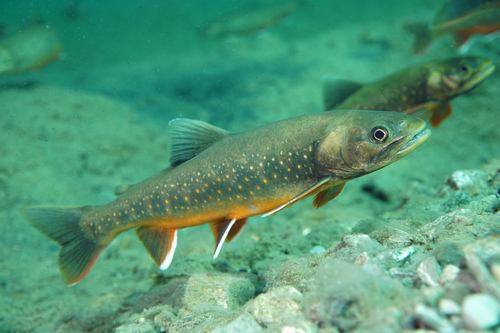
Arctic Char
Salvelinus alpinus
A master of the frozen north, the Arctic Char is the world's northernmost freshwater fish. Famous for its breathtaking red spawning colors and its ability to thrive in icy alpine lakes, this resilient species is a true icon of the Arctic wilderness.
Quick Identification
Size
Typically 25–76 cm (10–30 inches) in length; weighing between 0.5–4.5 kg (1–10 lbs), though some anadromous individuals can reach 9 kg (20 lbs).
Colors
Back is dark olive or blue-grey; sides are silvery with scattered pink, red, or cream-colored spots. Spawning males develop brilliant orange or deep red bellies and fins.
Key Features
- White leading edges on the pectoral, pelvic, and anal fins
- Small, cycloid scales giving a smooth appearance
- Slightly forked tail fin
- Vibrant red or orange coloration during the spawning season
When You’ll See Them
Geographic range
Where Does the Arctic Char Live?
The Arctic Char has the most northerly distribution of any freshwater fish, spanning the entire circumpolar region of the Holarctic. It is native to the cold waters of northern Canada, Greenland, Iceland, Scandinavia, and Russia, as well as high-altitude alpine lakes in the United Kingdom and Central Europe. In North America, its core range extends from the northern tip of Alaska across the Canadian Arctic Archipelago to the coastal waters of Newfoundland and Maine.
Basemap © OpenStreetMap contributors
Behavior
Arctic Char are highly adaptable fish that exhibit two primary life strategies: anadromous (migrating between freshwater and the sea) and landlocked (remaining in deep, cold lakes). They are known for being exceptionally hardy, surviving in some of the most remote and frigid environments on Earth. In the wild, they are social during the juvenile stage but become more solitary and territorial as they mature, especially during the autumn spawning season when males compete for females over gravel beds.
These fish are opportunistic and aggressive feeders. Their behavior is dictated largely by water temperature; they prefer temperatures below 10°C (50°F) and will retreat to the deepest parts of lakes or out to sea to find these conditions. While generally wary of humans, they are a prized target for sustainable catch-and-release angling in northern communities and are vital to the cultural and nutritional heritage of Arctic indigenous peoples.
EverydayEarth exclusive
Camera Tips
Capturing the elusive Arctic Char with an AI-powered camera requires a specialized underwater setup. Because these fish live in extremely clear, cold water, visibility is usually excellent, but the challenge lies in camera placement. If you are using a waterproof trail camera or a GoPro-style housing, mount the camera at a depth of 1-3 feet during the autumn spawning season. Position the lens to face a gravel-bottomed area where the current slows down, as these are the primary sites where char gather to spawn and defend territories.
For the best results, use a weighted tripod or a secure rock mount to prevent the camera from being moved by the current. If you are monitoring a 'backyard' stream in a northern latitude, aim the camera across the stream channel rather than directly up or down stream to maximize the 'trigger time' as the fish swims through the frame. Use a camera with a high frame rate (60fps or higher) to capture the quick, darting movements characteristic of salmonids.
Lighting is crucial in deep or murky water, but Arctic Char are often easily spooked by intense artificial light. Rely on natural sunlight during the long Arctic summer days. If you are filming in the late autumn, look for cameras with high-quality low-light sensors rather than infrared LEDs, which can reflect off the fish's scales and blow out the image. Polarizing filters on your lens can also help reduce surface glare if the camera is positioned just below or above the water line.
Similar Species
Species that look similar or are commonly confused with Arctic Char.
Brook Trout
Brook trout have distinctive worm-like markings on their backs, whereas Arctic Char have a solid dark back with light spots.
Dolly Varden
Extremely similar, but Dolly Varden typically have a thicker tail base and more spots concentrated on their sides compared to the Char.
Lake Trout
Lake trout have a much more deeply forked tail and generally lack the bright red or orange spawning colors seen in Arctic Char.
Frequently Asked Questions
Record Arctic Char at your habitat
Connect a camera to start building your own species record — AI identifies every visitor automatically.