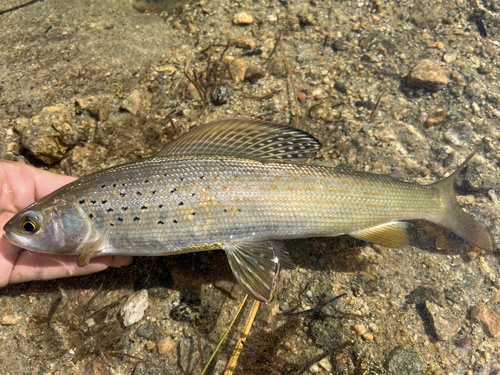
Arctic Grayling
Thymallus arcticus
The 'Sailfish of the North' is a dazzling iridescent gem found in the world's most pristine, ice-cold waters, easily recognized by its magnificent, oversized dorsal fin.
Quick Identification
Size
Typically 30-50 cm (12-20 inches) and 0.5-1.5 kg (1-3 lbs); can reach up to 76 cm (30 inches).
Colors
Iridescent silver-to-purple body; spectacular dorsal fin with rows of pink, orange, or red spots and an iridescent blue border.
Key Features
- Massive, sail-like dorsal fin with colorful spotting
- Shimmering iridescent scales reflecting purple, teal, and gold
- Small, trout-like mouth with fine teeth
- Deeply forked tail and slender, hydrodynamic profile
When You’ll See Them
Geographic range
Where Does the Arctic Grayling Live?
The Arctic Grayling is a true survivor of the far north, native to the vast Arctic and Pacific drainages of Canada, Alaska, and across the Siberian wilderness of Russia. In the contiguous United States, their native range is remarkably narrow, centered primarily on the upper Missouri River drainage in Montana. However, adventurous anglers can also find introduced populations in high-altitude 'sky island' lakes across the American West, including the White Mountains of Arizona, the Uinta Mountains of Utah, and the rugged Teton Range of Wyoming.
Basemap © OpenStreetMap contributors
Behavior
Arctic Grayling are highly visual predators that spend the majority of their day positioned in the current of clear, cold streams. They are famous for their "rise," frequently surfacing to intercept terrestrial insects that have fallen onto the water's surface. Unlike many other salmonids that can be quite elusive, Grayling are notably curious and gregarious, often congregating in small schools within deeper pools or in the slack water found behind large river boulders.
During the spring thaw, these fish engage in significant spawning migrations, traveling from large rivers or ice-covered lakes into smaller, gravel-bottomed tributaries. They are considered an indicator species for environmental health, as they require high dissolved oxygen levels and very low turbidity to thrive. Their interaction with humans is mostly defined by catch-and-release fly fishing, where they are admired for their striking beauty and willingness to strike at surface lures.
EverydayEarth exclusive
Camera Tips
Capturing the Arctic Grayling requires specialized equipment, as they are almost exclusively found underwater. A waterproof action camera or a dedicated underwater trail camera is essential. To get the best shots, look for "seams" in the river—areas where fast-moving water meets a slower eddy. Grayling love to sit in these transition zones, waiting for the current to deliver food directly to them. Position your camera on a weighted tripod or a heavy river stone, facing slightly upstream to catch their approach.
Because Grayling are highly visual and curious, you can often use a "lure" to bring them into the frame. A shiny metal spoon (with the hook removed for safety) or a brightly colored fly tied to a thin mono-filament line and suspended in front of the lens can entice a Grayling to investigate. The iridescence of their scales is best captured in bright, midday sun when the light can penetrate the water and reflect off their silver-and-purple flanks.
Set your camera to a high frame rate, at least 60fps, because their movements are incredibly swift when they strike at an insect. If you are filming in a high-altitude lake rather than a stream, place your camera near submerged structures like fallen logs or large rocks where the fish congregate. During the summer months, the water is at its clearest, providing the best visibility for your lens before the autumn rains increase turbidity.
Similar Species
Species that look similar or are commonly confused with Arctic Grayling.
Frequently Asked Questions
Record Arctic Grayling at your habitat
Connect a camera to start building your own species record — AI identifies every visitor automatically.