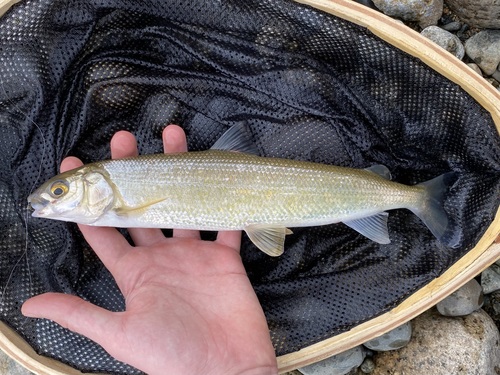
Mountain Whitefish
Prosopium williamsoni
A silver-scaled gem of western rivers, the Mountain Whitefish is a master of the cold-water current. Discover this social and resilient salmonid that thrives in North America's most pristine mountain watersheds.
Quick Identification
Size
25–50 cm (10–20 inches) in length; 0.5–1.8 kg (1–4 lbs) in weight
Colors
Silvery-white sides with an olive-green to bronze-brown back; fins are generally clear or dusky without prominent spots
Key Features
- Small, downward-pointing mouth with a slightly 'pig-like' snout
- Large, coarse scales and a slender, cylindrical body
- Adipose fin present behind the dorsal fin
- Lacks the dark spots found on most trout and salmon
When You’ll See Them
Geographic range
Where Does the Mountain Whitefish Live?
Native to the pristine watersheds of western North America, the Mountain Whitefish thrives from the Mackenzie River basin in Canada's Northwest Territories southward through the Pacific Northwest. Its core range encompasses the cold-water systems of British Columbia, Washington, Oregon, Idaho, and Montana, extending to the high-altitude drainages of Nevada and Utah. Whether in the upper Missouri River or the Truckee River, these fish are a signature species of healthy western mountain environments.
Basemap © OpenStreetMap contributors
Behavior
Mountain Whitefish are highly social, schooling fish that prefer the cold, clear waters of mountain rivers and lakes. Unlike their more aggressive cousins, the trout, they are primarily bottom-feeders, using their sensitive snouts to forage for aquatic larvae among the rocks and gravel. They are active year-round and do not hibernate, often remaining active and feeding even under thick ice in winter.
While they are sometimes overlooked by anglers in favor of trout, they are essential to the ecosystem and exhibit fascinating social dynamics. During the day, they tend to congregate in deep, slow-moving pools to avoid predators. As evening approaches, they move into shallower riffles or the edges of the current to feed more aggressively on drifting insects, often creating subtle 'rings' on the water surface that resemble trout rises.
EverydayEarth exclusive
Camera Tips
Capturing the Mountain Whitefish on camera requires an underwater setup, such as a specialized submersible trail cam or an action camera in a waterproof housing. Position your camera in 'tail-outs' or the transition zones where a deep pool begins to shallow into a riffle. This is where whitefish naturally congregate to feed on drifting insects. Facing the camera slightly downstream or across the current will provide the most stable footage and capture fish as they hold position against the flow.
Clarity is key for these silver-scaled fish. Use a polarizing filter if the camera is near the surface to reduce glare, and try to film during the 'golden hours' of early morning or late afternoon when the light penetrates the water at an angle, highlighting their iridescent scales. Since they are bottom-feeders, aim the camera towards the substrate. You can occasionally attract a school by gently turning over a few rocks upstream to release natural 'drift'—aquatic larvae—which will draw the fish into your frame.
For best results, use a high frame rate (60fps or higher) to capture their quick, darting movements. During the fall spawning season (October to December), look for gravel bars in shallower water where you might witness their schooling behavior and mating displays. Avoid using bright artificial lights at night, as this can spook the fish; instead, rely on high-quality ambient light or low-glow infrared if your equipment is specifically designed for aquatic use.
Similar Species
Species that look similar or are commonly confused with Mountain Whitefish.
Lake Whitefish
Larger and deeper-bodied than the Mountain Whitefish, with two flaps in each nostril instead of one.
Round Whitefish
Has a more restricted northern range and a much more rounded snout than the Mountain Whitefish.
Rainbow Trout
Easily distinguished by the presence of many small black spots on the body and fins, and a pinkish-red lateral stripe.
Frequently Asked Questions
Record Mountain Whitefish at your habitat
Connect a camera to start building your own species record — AI identifies every visitor automatically.