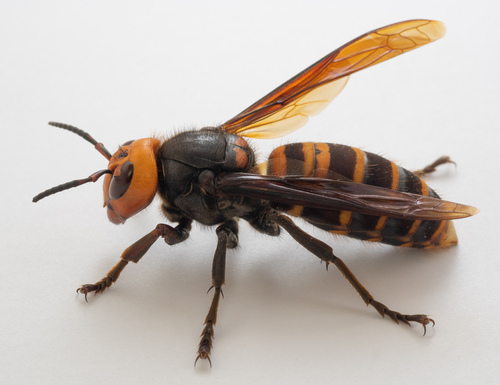
Asian Giant Hornet
Vespa mandarinia
Meet the world's largest hornet, a striking and powerful apex predator of the Asian forest. Known for its massive size and distinctive orange head, this formidable flyer is a master of the undergrowth.
Quick Identification
Size
Body length 4.5–5 cm (1.8–2 in); Wingspan up to 7.5 cm (3 in); Weight up to 3.5g
Colors
Bright orange-yellow head; dark brown or black thorax; abdomen with alternating bands of dark brown and yellow-orange
Key Features
- Massive solid orange head with large mandibles
- Dark thorax contrasting with a striped abdomen
- World's largest hornet size, exceeding 1.5 inches
- Subterranean nesting habit usually near tree roots
When You’ll See Them
Geographic range
Where Does the Asian Giant Hornet Live?
The Asian Giant Hornet is widely distributed across the temperate and tropical regions of East and South Asia. Its native range extends from the southern reaches of the Russian Far East and Japan, through the Korean Peninsula, and across much of eastern and southern China. It is also commonly found in the subtropical forests of Vietnam, Thailand, and Myanmar, reaching as far west as the Himalayan foothills in India and Sri Lanka. While there was a brief period of concern following sightings in the Pacific Northwest of North America, those populations were intensely managed and successfully eradicated by late 2024.
Basemap © OpenStreetMap contributors
Behavior
As apex predators, they have a complex relationship with other insects. They are most famous for their 'slaughter phase,' where a small group of hornets can decimate an entire honeybee hive in hours to secure the protein-rich larvae inside. Despite their fearsome reputation, they play a vital role in their ecosystem by controlling populations of agricultural pests like beetles and large caterpillars.
EverydayEarth exclusive
Camera Tips
Using lures can significantly increase your chances of a close-up shot. A mixture of fermenting fruit, such as overripe peaches or bananas mashed with a splash of rice wine or sugar water, is irresistible to them during the foraging season. Place the bait on a flat stone or a stump within the camera's focal range. Because these insects move with incredible speed, you must use a camera with a high-speed trigger (less than 0.2 seconds) and set it to take multiple bursts of photos or high-frame-rate video to avoid getting nothing but a blur.
Safety is the most important factor when filming this species. Never attempt to place a camera near a known nest entrance without professional protective gear and expert supervision. For most backyard observers in their native range, placing the camera near the perimeter of a garden where they hunt other insects is the safest and most effective method. Use a macro-focus setting if available, as the high-resolution detail of their massive orange head and powerful mandibles is what makes for a truly professional-grade wildlife capture.
Similar Species
Species that look similar or are commonly confused with Asian Giant Hornet.
Frequently Asked Questions
Record Asian Giant Hornet at your habitat
Connect a camera to start building your own species record — AI identifies every visitor automatically.