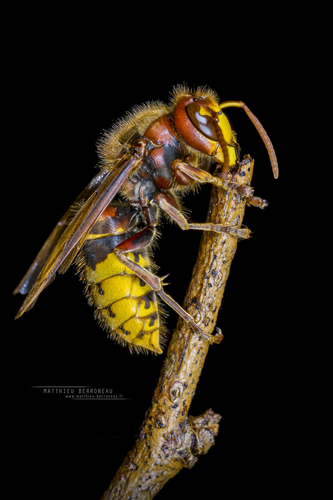
European Hornet
Vespa crabro
The largest true hornet in the West, the European Hornet is a masterful architect and a unique nocturnal hunter that often visits backyard lights.
Quick Identification
Size
25-35 mm (1-1.4 inches) for workers; queens can reach up to 40 mm (1.6 inches)
Colors
Distinctive reddish-brown head and thorax; yellow abdomen with black bands and characteristic teardrop markings
Key Features
- Large size, significantly bigger than standard yellowjackets
- Reddish-brown coloring on the head, legs, and thorax
- Yellow abdomen with black teardrop-shaped spots
- Wide vertex (the space on the head behind the eyes)
When You’ll See Them
Geographic range
Where Does the European Hornet Live?
The European Hornet is native to the temperate regions of Europe and Asia, ranging from the British Isles through Russia to Japan, and extending south into parts of North Africa. In the mid-19th century, it successfully crossed the Atlantic and established itself in North America, where it is now widely distributed throughout the eastern United States and southeastern Canada. This species is highly adaptable, thriving in any environment where mature trees and man-made structures provide suitable nesting cavities.
Basemap © OpenStreetMap contributors
Behavior
European Hornets are the gentle giants of the social wasp world, often unfairly feared because of their intimidating size and loud hum. Unlike their more irritable yellowjacket cousins, these hornets are generally non-aggressive unless their nest is directly threatened or they are stepped on. They live in eusocial colonies of 200 to 400 individuals, led by a single queen who initiates the nest in early spring using chewed wood fibers to create a papery pulp.
One of their most unique traits is their activity cycle; they are among the few wasps that are active both during the day and well into the night. It is common to see them hunting moths around porch lights or banging against window screens after dark. Within the colony, they exhibit complex social behaviors including 'worker policing,' where workers prevent each other from laying eggs to ensure the queen remains the sole producer of offspring.
EverydayEarth exclusive
Camera Tips
Capturing the European Hornet on your backyard camera is an exciting challenge because they are such active fliers. To increase your success, look for 'sap bleeds' on hardwood trees like oaks or maples. These hornets are highly attracted to the sweet, fermenting sugars of tree sap. Mount your camera about 3-5 feet from the trunk, focusing on the damp patches of bark. Use a high shutter speed or a 'sports mode' setting if your camera allows, as their wing beats are incredibly fast and can easily blur.
Because they are uniquely nocturnal, your best bet for high-quality footage is to set up your camera near an outdoor light source. If you have a porch light or a backyard security light, position your camera to face a nearby wall or screen where the hornets might land to rest or hunt for moths. The infrared night vision on many trail cameras works well, but a camera that can trigger with a white-light flash or stay in color mode under artificial light will show off their beautiful reddish-brown and yellow markings much better.
If you want to lure them into a specific frame, a bowl of overripe fruit like peaches, pears, or grapes can be very effective in late summer. Place the bait on a elevated platform or stump to keep it away from ground-dwelling scavengers. Position your camera approximately 24-36 inches from the bait for a clear macro-style view. Since these hornets are active late into the autumn, keep your cameras out until the first hard frost, which is when the colony activity typically peaks before the workers die off and the new queens go into hibernation.
Similar Species
Species that look similar or are commonly confused with European Hornet.
Frequently Asked Questions
Record European Hornet at your habitat
Connect a camera to start building your own species record — AI identifies every visitor automatically.