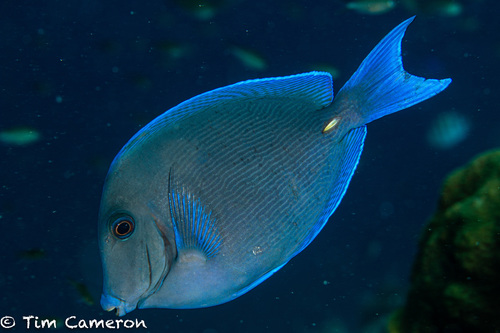
Atlantic Blue Tang
Acanthurus coeruleus
Meet the reef's most colorful gardener. The Atlantic Blue Tang is a vibrant surgeonfish famous for its striking color transformation and its vital role in keeping coral reefs healthy and algae-free.
Quick Identification
Size
Grows to 23-39 cm (9-15 inches) in length; typically weighs between 0.5-0.9 kg (1.1-2 lbs).
Colors
Adults are deep blue to purple with subtle grey horizontal lines; juveniles are bright neon yellow. Sub-adults may show a mix with a blue body and yellow tail.
Key Features
- High-bodied, pancake-like oval shape
- Vibrant deep blue or purple coloration in adults
- Yellow 'scalpel' spine at the base of the tail
- Bright yellow juvenile phase distinct from adult form
When You’ll See Them
Sightings on EverydayEarth
Aug 1, 2026
In a sunny, shallow reef area with a sandy floor, a Spotted Trunkfish swims slowly across the frame, showcasing its black-spotted pattern. The footage then transitions to a deeper, blue-water environment along a steep reef wall, where a school of Bar Jacks and a bright Atlantic Blue Tang swim past coral formations.
Jul 28, 2026
An initial phase Stoplight Parrotfish swims across the reef floor in the foreground, while several bright yellow Bluehead Wrasse and blue Atlantic Blue Tangs navigate the water column around large, swaying sea fans.
Jul 21, 2026
A vibrant reef scene where a school of Blue Chromis swims actively around large sea fans. Several Caribbean Bluehead Wrasse in their yellow initial phase move quickly through the foreground and background. A bright yellow juvenile Atlantic Blue Tang is also visible navigating through the coral structures near the bottom of the frame.
Jul 20, 2026
The reef is bustling with activity as several species of tropical fish navigate the coral structures. Bicolor Damselfish are active near the substrate, while a terminal phase Bluehead Wrasse and a Blue Tang swim through the open water. In the background, a school of Sergeant Majors drifts above the reef wall.
Jul 19, 2026
A vibrant reef community is active around a large sea fan and several gorgonians. A Bicolor Damselfish is seen clearly in the foreground, defending its territory near the sea fan. To the left, an Atlantic Blue Tang swims through the reef structure, while a school of small Blue Chromis drifts in the clear water above. Several yellow Bluehead Wrasses are also visible foraging among the coral heads.
Jun 20, 2026
A diverse array of tropical reef fish are active around a large sea fan and coral outcropping. A large Stoplight Parrotfish in its terminal phase swims gracefully from left to right across the foreground. Several Blue Tangs are visible in the background, while schools of French Grunts and Sergeant Majors move through the water column. Smaller Bicolor Damselfish are seen hovering close to the safety of the reef structure.
Geographic range
Where Does the Atlantic Blue Tang Live?
The Atlantic Blue Tang is a quintessential resident of the tropical and subtropical waters across the Western Atlantic. Its native range begins as far north as New York and Bermuda, extending down through the Gulf of Mexico and the entire Caribbean Sea to the coast of Brazil. They are most commonly found in high-density populations around the coral-rich waters of Florida, the Bahamas, and the Antilles, where the warm currents provide the perfect environment for their algae-rich diet.
Basemap © OpenStreetMap contributors
Recorded on EverydayEarth
Behavior
The Atlantic Blue Tang is a tireless worker of the reef, often referred to as a 'grazer.' These fish spend the vast majority of their daylight hours nipping at algae growing on coral and rocks. By keeping algae populations in check, they prevent the reef from being smothered, which allows coral polyps to thrive. They are highly social and are frequently seen in large schools, sometimes numbering in the hundreds, which helps them overwhelm the defenses of territorial damselfish.
Interestingly, Blue Tangs are also frequent visitors to 'cleaning stations.' At these specific locations on the reef, they hover patiently while smaller fish, like cleaner wrasses or gobies, pick parasites and dead skin off their bodies. While generally peaceful toward other species, they can be quite protective of their personal space and will use their razor-sharp tail spines to swipe at rivals if a hierarchy needs to be established.
EverydayEarth exclusive
Camera Tips
To capture the Atlantic Blue Tang on an underwater backyard or dock-mounted camera, placement is everything. These fish are 'benthic grazers,' meaning they stay close to the bottom where algae grows. Position your camera 1-3 meters deep, angled slightly downward toward a rocky outcropping or a patch of brain coral. Since they are diurnal, you won't need infrared lighting; instead, rely on the natural 'golden hour' light in the mid-morning or late afternoon when the sun penetrates the water at an angle, making their blue scales pop.
If you are using a camera in a tidal area, try to time your recording for the incoming tide. This is when water clarity is usually at its peak, and Blue Tangs are most active as the cooler, nutrient-rich water stimulates their feeding behavior. If you have the ability to place a 'lure,' consider a secured clip of dried seaweed (nori); this is a common technique used by aquarium enthusiasts that works just as well in the wild to keep a school of Tangs in front of the lens for an extended period.
Because these fish move with a distinct, flapping motion of their pectoral fins, use a high frame rate setting (at least 60fps) to avoid motion blur. Saltwater environments are harsh, so ensure your camera housing is treated with an anti-foulant or cleaned weekly to prevent algae from growing on the lens itself—the very thing the Blue Tang loves to eat could end up blocking your view! Finally, look for 'cleaning stations'—areas where smaller fish congregate—as Blue Tangs will often stop there and remain nearly motionless for several minutes, providing the perfect portrait opportunity.
Similar Species
Species that look similar or are commonly confused with Atlantic Blue Tang.
Frequently Asked Questions
Record Atlantic Blue Tang at your habitat
Connect a camera to start building your own species record — AI identifies every visitor automatically.