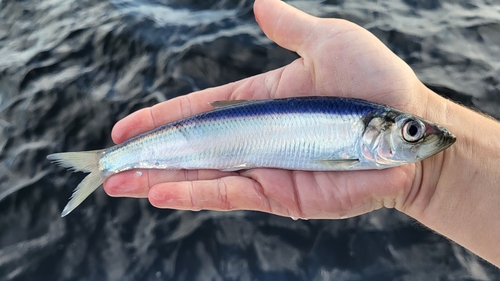
Atlantic Herring
Clupea harengus
The Atlantic Herring is the 'Silver of the Sea,' a shimmering marvel of the North Atlantic that moves in massive, synchronized schools. As a cornerstone of the marine food web, these iridescent fish power everything from humpback whales to coastal economies.
Quick Identification
Size
25–45 cm (10–18 in) in length; weight typically up to 1.1 kg (2.4 lbs)
Colors
Iridescent steel-blue to greenish back with brilliant silver-white sides and belly; no spots on the body or fins
Key Features
- Deeply forked tail fin
- Protruding lower jaw with a subtle point
- Smooth, streamlined scales without a prominent lateral line
- Single dorsal fin located at the midpoint of the back
When You’ll See Them
Geographic range
Where Does the Atlantic Herring Live?
Native to the temperate and subarctic waters of the North Atlantic, the Atlantic Herring is found from the northeastern United States and Greenland across to the Norwegian Sea and the Bay of Biscay. They are particularly concentrated in the North Sea and the Gulf of Maine, where cold, nutrient-rich currents support the massive plankton blooms they require. While strictly a saltwater species, they are often found in brackish estuaries during various stages of their life cycle.
Basemap © OpenStreetMap contributors
Behavior
Atlantic Herring are social superstars of the ocean, living in massive, synchronized schools that can reach volumes of several cubic kilometers. These schools act as a single, shimmering organism to confuse predators, a behavior known as shoaling. Interestingly, herring communicate and maintain school density through 'FRTs' (Fast Repetitive Ticks)—high-frequency sounds produced by releasing air from their anal duct, which helps them stay together in the dark.
These fish exhibit a fascinating daily routine called diel vertical migration. During the day, they retreat to deeper, darker waters to avoid visual predators like tuna and gannets. As the sun sets, they rise toward the surface to feed on plankton. While they generally avoid human contact, they are a vital resource for coastal communities and are frequently seen near piers, bridges, and harbor walls during their seasonal spawning migrations.
EverydayEarth exclusive
Camera Tips
Capturing Atlantic Herring on camera requires specialized underwater equipment, as they rarely break the surface. For backyard enthusiasts living on the coast, the best approach is a submersible 'fishing' camera or an action camera in a waterproof housing mounted to a dock piling or a weighted crab trap. Position the camera between 2 to 5 meters deep, as this is the 'sweet spot' where herring often congregate when moving into shallower coastal waters.
Because herring are highly reflective, lighting is your greatest challenge. In direct sunlight, their silver scales can 'blow out' the image, resulting in a white flash. Aim your camera slightly downward or away from the sun to capture the iridescent blues and greens of their backs. If you are filming at night—which is when they are most active near the surface—use a soft red or dimmed white light; intense bright lights may trigger a 'startle' response, causing the entire school to vanish in a split second.
Technical settings are crucial for such fast-moving subjects. Set your camera to at least 60 frames per second (fps) to catch the fluid motion of the school and the rapid vibrations of their tails. If your camera supports it, a wide-angle 'fisheye' lens is ideal, as it allows you to capture the sheer scale of the school rather than just individual fish. High-bitrate video is also recommended to prevent the shimmering scales from turning into digital 'blocky' artifacts.
To draw a school into your camera’s field of view, try using a mesh 'chum bag' filled with oily fish meal or crushed shellfish tied just above the camera. The scent trail will encourage the school to linger. Always check your local tide charts; the clearest footage is usually captured during 'slack tide' when the water movement slows down and sediment settles, providing the high visibility needed for professional-quality marine wildlife shots.
Similar Species
Species that look similar or are commonly confused with Atlantic Herring.
Frequently Asked Questions
Record Atlantic Herring at your habitat
Connect a camera to start building your own species record — AI identifies every visitor automatically.