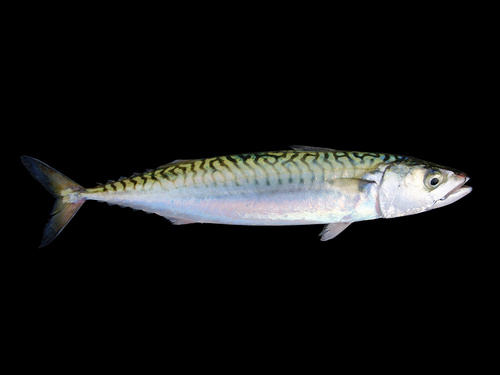
Atlantic Mackerel
Scomber scombrus
A masterpiece of marine engineering, the Atlantic Mackerel is famous for its shimmering iridescent scales and lightning-fast speed. These nomadic voyagers travel in vast, synchronized shoals, bringing the silver energy of the open ocean to our coastlines.
Quick Identification
Size
Typically 30 to 45 cm (12 to 18 inches) in length; weighs between 0.5 and 1.5 kg (1.1 to 3.3 lbs).
Colors
Iridescent steel-blue back with dark, wavy 'tiger' stripes; silvery-white belly with hints of purple and green iridescence.
Key Features
- Dark wavy vertical bars on the upper half of the body
- Deeply forked tail with five small finlets near the base
- Two widely separated dorsal fins
- Streamlined, spindle-shaped body without a swim bladder
When You’ll See Them
Geographic range
Where Does the Atlantic Mackerel Live?
Native to the temperate regions of the North Atlantic Ocean, the Atlantic Mackerel is a wide-ranging traveler found on both sides of the pond. In the Western Atlantic, they are commonly found from the coast of Labrador, Canada, down to Cape Hatteras in North Carolina. Across the Atlantic, their range spans from the northern waters of Norway and Iceland, through the North Sea and Baltic Sea, and down into the Mediterranean and Black Seas. While they occasionally stray into more northern or southern latitudes, they are most concentrated along the continental shelves of Europe and North America.
Basemap © OpenStreetMap contributors
Behavior
Atlantic Mackerel are highly social, pelagic fish that congregate in massive schools, sometimes containing thousands of individuals. Because they lack a swim bladder, they must remain in constant motion to stay buoyant and ensure a steady flow of oxygenated water through their gills. This perpetual movement makes them one of the fastest and most energetic fish in temperate coastal waters, often seen darting in synchronized patterns to evade predators or corral prey.
These fish exhibit complex migratory behaviors driven by water temperature and food availability. During the spring and summer, they move into shallower coastal waters to feed and spawn, often appearing in large numbers near piers and harbors. As the ocean cools in late autumn, they retreat to deeper, warmer waters along the edge of the continental shelf. While they are naturally skittish, their curiosity can sometimes bring them close to underwater structures, making them a fascinating subject for coastal observation.
EverydayEarth exclusive
Camera Tips
Capturing the Atlantic Mackerel on camera requires a specialized underwater approach, as they never leave the water. For those with 'backyard' access to a dock, pier, or bulkhead, the most effective method is using a stationary underwater camera housing or a drop-cam rigged to a piling. Position the camera at a depth of 2 to 4 meters, facing outward into the current. Mackerel are attracted to areas where moving water concentrates plankton, so placing your camera near the edge of a tidal flow is ideal.
Because mackerel are exceptionally fast swimmers, your camera settings are critical. Use a high shutter speed (1/500s or higher) and a frame rate of at least 60fps to prevent motion blur as the school flashes by. Since they are highly reflective, avoid using direct artificial light during the day, which can cause 'blown-out' highlights on their silvery scales. Instead, rely on natural sunlight filtered through the water, which beautifully highlights their iridescent blue-green patterns and dark tiger stripes.
To attract mackerel to your camera's field of view without using traditional bait, you can utilize 'flashers'—shiny, spinning pieces of metal suspended in the water column. The movement and light reflection mimic a small school of baitfish, often drawing mackerel in to investigate. Seasonal timing is also vital; in the North Atlantic, the best footage is captured between June and August when the fish are in their peak shoreward migration and water clarity is generally at its highest.
Similar Species
Species that look similar or are commonly confused with Atlantic Mackerel.
Frequently Asked Questions
Record Atlantic Mackerel at your habitat
Connect a camera to start building your own species record — AI identifies every visitor automatically.