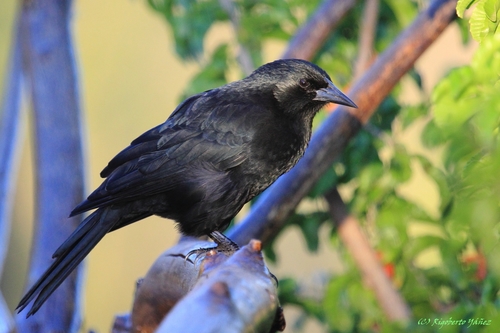
Austral Blackbird
Curaeus curaeus
The iconic 'Tordo' of the South, the Austral Blackbird is a master of melody and a social star of the Andean foothills. With its shimmering jet-black feathers and bold personality, it is a rewarding visitor for any backyard observer.
Quick Identification
Size
25-28 cm (10-11 in) in length; wingspan approximately 40 cm (16 in); weight ranges from 80-110g (2.8-3.9 oz)
Colors
Uniformly glossy jet-black plumage with a subtle bluish or greenish sheen in direct sunlight; black bill, legs, and eyes. Males and females are identical in appearance.
Key Features
- Entirely coal-black plumage without any markings
- Long, stout, and slightly curved black bill
- Graduated tail that appears rounded in flight
- Complex, flute-like whistling calls often delivered in duets
When You’ll See Them
Geographic range
Where Does the Austral Blackbird Live?
The Austral Blackbird is a signature species of the Southern Cone of South America. It is natively found across the length of Chile, from the Atacama region in the north down to the rugged archipelago of Tierra del Fuego. Its range extends eastward into the Andean foothills and Patagonian plains of western and southern Argentina. While most populations are permanent residents, those living in the extreme southern reaches of Patagonia may migrate slightly northward during the harshest winter months to find more stable food sources.
Basemap © OpenStreetMap contributors
Behavior
The Austral Blackbird, locally known in Chile as the 'Tordo,' is a highly gregarious and intelligent species. They are rarely seen alone, usually moving in small family groups or larger flocks of up to 30 individuals. These birds are famous for their remarkable vocalizations, which include a wide array of melodious whistles, harsh chatters, and liquid notes. They are often seen foraging together on the ground, using their powerful bills to flip over debris or probe the soil.
In human-dominated landscapes, they exhibit a bold and curious temperament. They are frequently found around farmsteads and suburban gardens, where they have learned to associate humans with easy food sources. Despite their social nature, they become highly territorial during the breeding season, with pairs working together to defend their nesting sites in dense thickets or tall trees. Their social structure is complex, often involving communal roosting and synchronized group movements.
EverydayEarth exclusive
Camera Tips
To capture the best footage of the Austral Blackbird, place your camera near ground level or on low-profile platforms. Since these birds are habitual ground foragers, setting your camera 12 to 24 inches off the ground near a patch of leaf litter or a cleared garden bed is ideal. They are particularly attracted to water, so a birdbath or a shallow ground-level water feature is one of the most effective ways to ensure they stop and linger in front of the lens.
If you are looking to bait your camera station, these birds are not picky. They are highly attracted to suet blocks, sunflower seeds, or even small portions of fruit like apples or grapes. In rural or suburban settings, they are known to investigate 'leftover' food, so a variety of kitchen scraps (within reason) can act as a powerful lure. Because they travel in groups, expect multiple subjects in the frame; using a wide-angle lens setting will help capture the social dynamics of the flock.
Lighting is your biggest challenge with a bird this dark. In high-contrast midday sun, the Austral Blackbird can look like a featureless black silhouette. Aim to position your camera facing away from the sun, and if possible, in an area with dappled light or bright shade. This will allow the camera's sensor to pick up the beautiful iridescent sheen of their feathers. For video, ensure your microphone is active; their rich, multi-layered songs are a highlight of any backyard recording.
Similar Species
Species that look similar or are commonly confused with Austral Blackbird.
Frequently Asked Questions
Record Austral Blackbird at your habitat
Connect a camera to start building your own species record — AI identifies every visitor automatically.