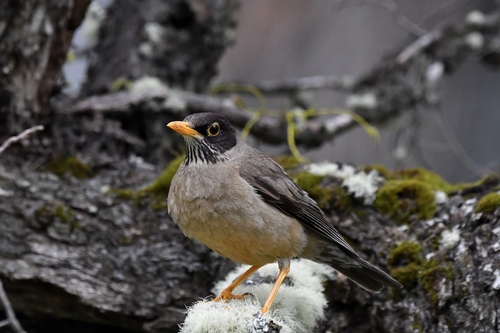
Austral Thrush
Turdus falcklandii
The Austral Thrush is the soulful voice of the southern Andes and the most familiar garden companion of the Southern Cone. With its striking orange bill and fearless personality, it brings a touch of wild melody to every backyard.
Quick Identification
Size
Length: 24–26 cm (9.4–10.2 in); Weight: 80–110 g (2.8–3.9 oz)
Colors
Olive-brown upperparts, ochre to fawn underparts, dark greyish-black crown, white throat with dark streaks, and bright yellow-orange bill and legs.
Key Features
- Bright yellow-orange bill and legs
- Streaked white and dark throat
- Olive-brown back with a noticeably darker head
- Upright posture and frequent tail-flicking
When You’ll See Them
Geographic range
Where Does the Austral Thrush Live?
Where Does the Austral Thrush Live? This species is the most common thrush of southern South America, claiming a native range that spans the temperate regions of Chile and Argentina. They are found from the Atacama fringe in the north all the way down to the rugged tip of Tierra del Fuego. Beyond the mainland, a robust and slightly larger subspecies is a well-known resident of the Falkland Islands, where it thrives across the coastal settlements and grassy plains.
Basemap © OpenStreetMap contributors
Behavior
In their social interactions, they are mostly solitary or found in pairs, though they may gather in small, loose groups where food is particularly abundant, such as a fruiting tree. They are known for their curiosity and will often follow gardeners who are digging in the soil, hoping to snag an easy meal of exposed earthworms or larvae. When alarmed, they give a sharp, clicking call and fly to the nearest low branch to observe the threat.
EverydayEarth exclusive
Camera Tips
Water is the single most effective way to draw an Austral Thrush into your camera's field of view. They are enthusiastic bathers and will visit a shallow birdbath or ground-level water feature multiple times a day. Position your camera 3-4 feet from the water source to ensure the motion trigger captures the action as soon as they land. If using an AI-powered camera, this close proximity will also help the software identify the streaked throat and orange bill with high precision.
During the spring breeding season, you can capture interesting territorial displays by placing a camera near low-hanging fruit trees or shrubs like Berberries or Hawthorn. For settings, use a fast shutter speed or high-frame-rate video if possible, as their movements can be quite twitchy and rapid. Because they are most active during the dim light of early morning, look for cameras with excellent low-light sensors to avoid grainy footage during their peak singing and foraging hours.
Similar Species
Species that look similar or are commonly confused with Austral Thrush.
Frequently Asked Questions
Record Austral Thrush at your habitat
Connect a camera to start building your own species record — AI identifies every visitor automatically.