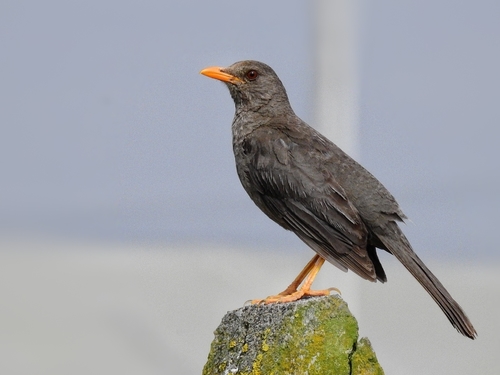
Chiguanco Thrush
Turdus chiguanco
A quintessential Andean songbird, the Chiguanco Thrush is as famous for its rich, fluting song as it is for its bold, sun-colored bill. Whether hopping through a misty mountain forest or a busy city park, this resilient thrush is a delightful neighbor for any backyard observer.
Quick Identification
Size
Length: 27–30 cm (10.6–11.8 in); Weight: 85–110 g (3.0–3.9 oz); Wingspan: 40–45 cm (15.7–17.7 in)
Colors
Uniformly dark sooty-brown or brownish-grey plumage; bright yellow-orange bill, legs, and eye-ring
Key Features
- Uniform dark sooty-brown plumage
- Bright yellow-orange bill and legs
- Distinct yellow orbital ring around the eye
- Large, robust thrush profile with a long tail
When You’ll See Them
Geographic range
Where Does the Chiguanco Thrush Live?
The Chiguanco Thrush is a hallmark species of the South American Andes, stretching from the northern highlands of Ecuador down through Peru and Bolivia into northern Chile and central Argentina. This hardy bird thrives in the mountainous corridors and high plateaus of the continent, often reaching elevations that would leave other thrushes breathless. While it is native to the rugged Andean landscape, it has successfully colonized human-dominated environments throughout its range, making it one of the most frequently spotted backyard birds in high-altitude cities across the region.
Basemap © OpenStreetMap contributors
Behavior
The Chiguanco Thrush is a bold and conspicuous presence in its habitat, often seen hopping across lawns or open ground in search of food. Like many members of the Turdus genus, it exhibits a 'run-and-pause' foraging technique, moving quickly across the grass before standing upright to scan for movement in the soil. While they are often solitary or found in pairs, they may congregate in small groups where food, such as a fruiting tree, is abundant.
In urban and suburban settings, these thrushes have become remarkably well-adapted to human activity. They are frequently found in gardens and city parks, where they may become quite tame and accustomed to people. Their song is a beautiful, fluting series of melodic whistles, most commonly heard during the early morning and late evening, contributing significantly to the 'dawn chorus' in Andean towns and mountain villages.
EverydayEarth exclusive
Camera Tips
To capture high-quality footage of the Chiguanco Thrush, place your camera low to the ground, ideally between 6 to 12 inches high. This species spends the vast majority of its time foraging on the floor, so a low-angle shot provides an intimate perspective of its 'run-and-stop' hunting behavior. Position the camera near a patch of damp soil or under a fruiting shrub, as these are high-traffic areas for a hungry thrush. If you have a backyard bird bath, this is the gold standard for camera placement; thrushes are enthusiastic bathers and will provide excellent, active footage.
Because they are most active during the 'golden hours' of dawn and dusk, ensure your camera's sensor is sensitive enough for low-light conditions. A fast trigger speed is essential, as these birds can move in quick, jerky bursts that might leave a slow camera with nothing but a blurry tail in the frame. If you are using a baited setup, scattered raisins, chopped suet, or mealworms can be highly effective lures, but ensure they are placed in a clear, well-lit spot to avoid the camera focusing on foreground vegetation instead of the bird.
In terms of settings, use a short-duration video mode (10-15 seconds) rather than still photos. The Chiguanco Thrush's vocalizations are half the charm of the species, so enabling audio recording can capture their melodic song or their sharp, clicking alarm calls. During the breeding season, keep an eye out for individuals carrying mud or dry grass in their beaks, and consider moving your camera near potential nesting sites in dense bushes, though always be careful not to disturb the birds during this sensitive time.
Similar Species
Species that look similar or are commonly confused with Chiguanco Thrush.
Frequently Asked Questions
Record Chiguanco Thrush at your habitat
Connect a camera to start building your own species record — AI identifies every visitor automatically.