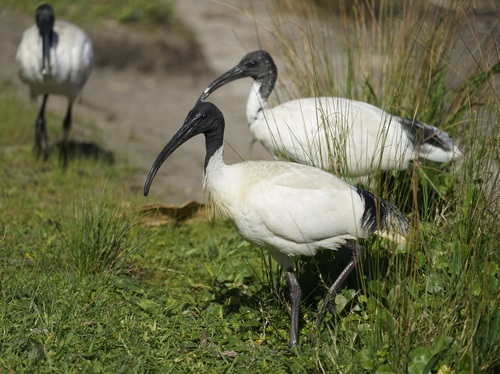
Australian Ibis
Threskiornis molucca
Meet Australia’s most misunderstood icon. From ancient wetlands to city parks, the Australian Ibis is a master of adaptation with a striking silhouette and a surprising history.
Quick Identification
Size
Length: 65–75 cm (25–30 in); Wingspan: 110–125 cm (43–49 in); Weight: 1.4–2.5 kg (3.1–5.5 lbs)
Colors
Body is predominantly white with black tips on the wings. The head and neck are bare of feathers and deep black. Legs and the long, downcurved bill are also black.
Key Features
- Long, black, downcurved 'sickle' bill
- Bald black head and neck contrasting with white body
- Black lacy feathers (scapular plumes) over the tail
- Distinctive slow, flapping flight pattern with intermittent glides
When You’ll See Them
Geographic range
Where Does the Australian Ibis Live?
Native to the Australian continent, this species is found across much of the mainland, though it is most concentrated in the north, east, and southwest. While they are iconic to Australia, their range extends northward into southern New Guinea, the Moluccas, and parts of the Indonesian archipelago. In recent decades, they have expanded significantly from inland wetlands into coastal urban centers as a response to changing water patterns in the interior.
Basemap © OpenStreetMap contributors
Behavior
Often affectionately or derisively known as the 'Bin Chicken,' the Australian Ibis is a highly intelligent and resilient bird. In their natural wetland habitats, they are communal foragers, often seen wading through shallow water or probing soft mud for food. They are very social, nesting in large, noisy colonies often shared with other waterbirds like spoonbills and cormorants.
In urban environments, their behavior has shifted remarkably. They have become bold scavengers, navigating city parks, outdoor cafes, and landfills with ease. Despite their urban reputation, they retain complex social structures and are skilled flyers, often traveling in V-formations between roosting sites and feeding grounds. They are generally peaceful toward humans but can be persistent when they spot an easy meal.
EverydayEarth exclusive
Camera Tips
To capture the Australian Ibis on a backyard camera, placement is key. Since they are ground-foragers, position your camera low—about 30 to 60 centimeters (1-2 feet) off the ground. Aiming the lens at a flat patch of lawn or near the edge of a backyard pond will yield the best results. Because they are large birds, ensure the camera has a wide enough field of view to capture their entire profile, especially that iconic long bill.
While we don't recommend leaving out human food (which can be bad for their health), a shallow, sturdy birdbath or a consistent water source is an excellent natural lure. They are most active during the mid-morning and late afternoon as they move between roosts. Set your camera’s trigger interval to a short delay, as Ibis often move in small groups; a fast trigger ensures you catch the whole family as they probe the ground for insects.
During the breeding season (usually starting in August), look for more complex social behaviors. You might capture them carrying nesting materials like sticks or reeds. If your camera has a 'Time Lapse' mode, try setting it to capture activity near tall trees or palms where they might be roosting. For the best image quality, position the camera so the sun is behind it, as their bright white feathers can easily 'blow out' or overexpose in direct, harsh sunlight.
Similar Species
Species that look similar or are commonly confused with Australian Ibis.
Straw-necked Ibis
Larger with dark, iridescent black feathers on the back and wings, and distinctive yellow 'straw' feathers on the neck.
Royal Spoonbill
Similar white plumage and size, but features a straight, flat, spoon-shaped bill rather than a curved one.
Glossy Ibis
Much smaller with deep reddish-brown and metallic green plumage rather than white.
Frequently Asked Questions
Record Australian Ibis at your habitat
Connect a camera to start building your own species record — AI identifies every visitor automatically.