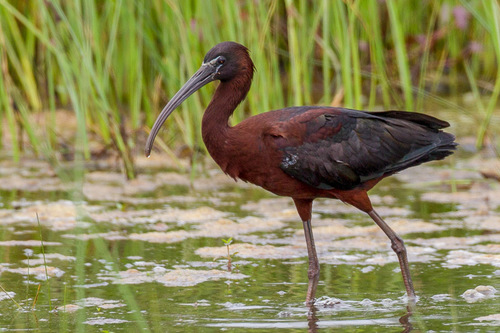
Glossy Ibis
Plegadis falcinellus
With its shimmering iridescent plumage and elegant curved bill, the Glossy Ibis is a stunning visitor to wetlands across the globe. Often mistaken for a dark shadow in the marsh, this bird reveals a rainbow of colors when caught in the right light.
Quick Identification
Size
Length: 48–66 cm (19–26 in); Wingspan: 80–105 cm (31–41 in); Weight: 485–580 g (1.1–1.3 lbs)
Colors
Deep maroon-chestnut body with metallic green and purple iridescence on the wings and tail; dark facial skin with a pale blue-white border during breeding.
Key Features
- Long, slender, down-curved 'sickle' bill
- Deep iridescent maroon plumage that looks black in low light
- Long legs that trail behind the tail in flight
- White facial border present during the breeding season
When You’ll See Them
Sightings on EverydayEarth
Jul 13, 2026
A diverse group of wading birds is gathered on a muddy bank at the water's edge. Several White Ibises and Glossy Ibises are actively probing the soft ground for food with their long, curved bills. A Tricolored Heron stands patiently near the water, while a Snowy Egret observes from the left. The birds move calmly through the shallow water and across the bank.
Geographic range
Where Does the Glossy Ibis Live?
Native to a vast portion of the globe, the Glossy Ibis is the most widespread ibis species in the world. Its range spans from the warm temperate regions of Europe and Asia through Africa and down to Australia. In the Americas, they are primarily found along the Atlantic and Gulf Coasts of the United States, extending through the Caribbean into northern South America. While they are core residents in tropical zones, northern populations are known for their impressive migratory journeys and nomadic tendencies, often appearing in new wetlands unexpectedly after heavy rains.
Basemap © OpenStreetMap contributors
Behavior
The Glossy Ibis is a highly social bird, almost always seen in flocks whether it is foraging, roosting, or nesting. They are famous for their elegant flight patterns, often flying in 'V' formations or long, wavy lines, alternating between several quick wingbeats and short glides. Within a colony, they are communicative, using various croaks and grunts, though they are generally silent when away from the nesting site.
When it comes to feeding, these birds are tactile foragers. They walk slowly through shallow water or mud, rhythmic probing with their long, sensitive bills to feel for prey. While they are wary of direct human contact, they have adapted well to human-altered landscapes, frequently visiting rice paddies, flooded pastures, and suburban drainage ponds where food is plentiful.
EverydayEarth exclusive
Camera Tips
To capture the true beauty of the Glossy Ibis, camera placement is everything. These birds are 'mud-probers,' so you want to position your camera at a low angle, roughly 12 to 18 inches off the ground, near the edge of a water feature or a marshy patch. If you have a backyard with a shallow pond or a muddy perimeter, this is the ideal spot. Aim the lens toward the east or west to take advantage of the 'Golden Hour' light, which is the only time the camera will truly pick up the spectacular purple and green iridescence in their feathers; otherwise, they often just look like dark silhouettes.
Because they are social and easily spooked, use a camera with a fast trigger speed and a high-quality PIR sensor to catch them as they land. Since they don't respond to traditional birdseed, you can attract them to a specific spot by maintaining a 'soft mud' zone. If your local regulations allow, small amounts of dried mealworms scattered in a shallow, muddy tray can sometimes pique their curiosity as they probe. Avoid using bright white flashes at night; instead, stick to 'No-Glow' or 'Black' infrared settings to ensure you don't startle the flock if they decide to roost nearby.
In terms of settings, video mode is highly recommended for this species. Seeing the tactile probing motion of the bill and the rhythmic 'stepping' of the bird provides much better identification data and more engaging footage than a static photo. Set your video length to at least 20 seconds, as these birds move slowly and deliberately. If your camera allows for interval shooting, set it to take a series of 3-5 photos to increase the chances of getting a shot where the bird's head is up and the facial markings are visible.
Similar Species
Species that look similar or are commonly confused with Glossy Ibis.
White-faced Ibis
Nearly identical but features red eyes and a white feather border that circles behind the eye during breeding season.
White Ibis
Easily distinguished by its bright white plumage and striking red-orange bill and legs.
Long-billed Curlew
While it has a similar bill, the Curlew is a mottled brown shorebird without the dark iridescent colors of the ibis.
Frequently Asked Questions
Record Glossy Ibis at your habitat
Connect a camera to start building your own species record — AI identifies every visitor automatically.