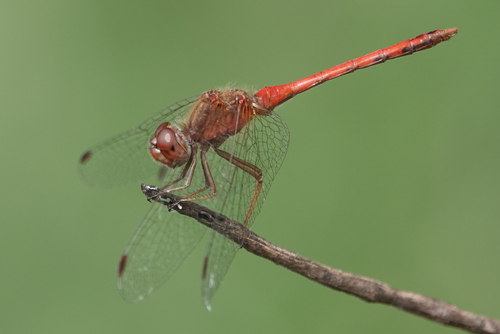
Autumn Meadowhawk
Sympetrum vicinum
The Autumn Meadowhawk is the late-season sentinel of the dragonfly world, bringing a flash of brilliant red to the garden long after summer has faded. Recognized by its unique yellow legs, this hardy insect is a favorite for backyard naturalists across North America.
Quick Identification
Size
26–35 mm (1.0–1.4 inches) in length; wingspan of 45–55 mm (1.8–2.2 inches)
Colors
Mature males are bright cherry-red with red faces; females and juveniles are golden-brown or yellowish-tan. Both sexes have distinctive pale yellow to light brown legs.
Key Features
- Pale yellow or tan legs (unique among meadowhawks)
- Bright red abdomen in mature males
- Small body size, often under 1.5 inches
- Tendency to fly very late into the autumn season
When You’ll See Them
Geographic range
Where Does the Autumn Meadowhawk Live?
The Autumn Meadowhawk is native to the North American continent, boasting a very wide distribution. Its range extends from the Atlantic coast of Canada and the United States across to the Pacific Northwest, reaching as far south as the Gulf Coast and northern Mexico. Because it is highly adaptable to human-altered landscapes, it is one of the most common dragonflies found in suburban backyards across temperate North America.
Basemap © OpenStreetMap contributors
Behavior
Autumn Meadowhawks are distinct for their incredible resilience to cold weather, often remaining active well into November after other dragonfly species have disappeared. They are categorized as 'perchers,' spending much of their day stationed on sun-lit twigs, rocks, or even bare ground. From these vantage points, they survey their surroundings for prey and rivals, making quick, darting flights to snatch small insects out of the air before returning to the same spot.
These dragonflies are particularly known for their late-season mating rituals. You will often see them flying in 'tandem,' where the male attaches himself to the female's head while she searches for a place to deposit eggs. Unlike many more skittish dragonfly species, Autumn Meadowhawks are relatively approachable, often allowing humans to get within a few feet, which makes them an ideal subject for backyard photography and observation.
EverydayEarth exclusive
Camera Tips
Capturing the Autumn Meadowhawk on camera requires a focus on their perching habits. Because they are cold-blooded, they seek out 'heat sinks' during the crisp fall mornings. Position your camera about 18 to 24 inches off the ground, aimed at a prominent, sun-exposed twig or a light-colored stone near a water feature. They have a strong site fidelity, meaning if you see one land on a specific branch, it will likely return to that exact spot dozens of times throughout the afternoon.
Lighting is your best friend with this species. To highlight the male's brilliant red body, try to place your camera so the sun is behind it or to the side, rather than shooting into the sun. This prevents the dragonfly from becoming a silhouette and captures the translucency of its wings. If your camera allows for focal range adjustments, set it to a macro or close-range setting, as these are small insects and can easily get lost in a wide-angle landscape shot.
While traditional bait doesn't work for dragonflies, you can attract them by creating a 'perching highway.' Place several upright bamboo stakes or dry sticks in an open, sunny area of your yard. If you have a backyard pond, the edges are the primary activity zone. Set your camera to a high-speed trigger or burst mode; the 'take-off' and 'landing' moments are the most dramatic, but their stationary perching posture allows for excellent high-resolution still portraits during the midday heat.
Similar Species
Species that look similar or are commonly confused with Autumn Meadowhawk.
Ruby Meadowhawk
The Ruby Meadowhawk has black legs and a more intensely red face compared to the Autumn Meadowhawk.
Cherry-faced Meadowhawk
Look at the legs; Cherry-faced Meadowhawks have solid black legs, while Autumn Meadowhawks have distinctively pale legs.
White-faced Meadowhawk
Identifiable by its stark white face and black legs, appearing earlier in the summer than the Autumn Meadowhawk.
Frequently Asked Questions
Record Autumn Meadowhawk at your habitat
Connect a camera to start building your own species record — AI identifies every visitor automatically.