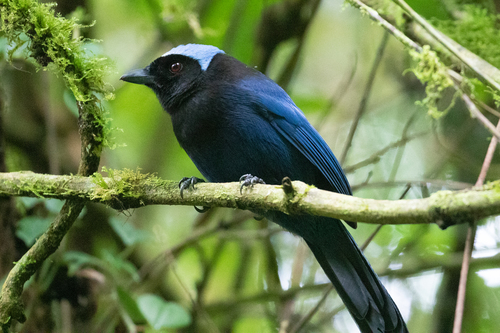
Azure-hooded Jay
Cyanolyca cucullata
A striking denizen of the misty cloud forests, the Azure-hooded Jay is easily recognized by its brilliant sky-blue crown and velvet-black mask. This intelligent and social corvid adds a flash of deep navy blue to the high-altitude jungles of Central America.
Quick Identification
Size
28–31 cm (11–12 in) in length; weight approximately 80–110g (2.8–3.9 oz)
Colors
Deep navy blue body, velvet black head and upper chest, brilliant sky-blue nape and crown with a thin white border. Sexes are monomorphic (look identical).
Key Features
- Brilliant sky-blue 'hood' on the crown and nape
- Velvety black facial mask and throat
- Thin white line separating the black face from the blue crown
- Deep navy blue wings and tail
When You’ll See Them
Geographic range
Where Does the Azure-hooded Jay Live?
Native to the mountain ranges of Middle America, the Azure-hooded Jay thrives in a narrow belt of high-altitude forest. Its core range begins in the Sierra Madre Oriental of Mexico and extends southward through the highlands of Guatemala, Honduras, El Salvador, and Nicaragua, reaching its southern limit in the mountains of Costa Rica and western Panama. This species is a permanent resident throughout its range, occupying the misty, moisture-rich 'cloud forest' zones where it rarely ventures into the dry lowlands.
Basemap © OpenStreetMap contributors
Behavior
Azure-hooded Jays are highly intelligent and social members of the crow family, though they tend to be more reclusive and shy than their North American cousins. They are typically found in small family groups or pairs, moving through the mid-to-upper canopy of humid mountain forests. They are known for their complex vocalizations, which include a variety of sharp metallic clicks, wheezing whistles, and harsh scolding notes that they use to communicate with their group or warn of predators.
While they are primarily canopy-dwellers, these jays are incredibly inquisitive and will occasionally descend to lower levels to investigate new food sources or disturbances. Their flight is characterized by steady wingbeats and agile maneuvering through dense foliage. Unlike many other jays, they are rarely seen in large flocks, preferring the tight-knit social structure of their immediate family unit.
EverydayEarth exclusive
Camera Tips
To capture the Azure-hooded Jay, camera placement is everything. Because they are montane specialists that spend much of their time in the canopy, you should aim to mount your camera at a higher vantage point if your terrain allows. If you have a sloping backyard that looks into the mid-story of a forest, place the camera on a sturdy limb facing a moss-covered branch. These birds are particularly attracted to epiphytes, so a camera aimed at a large bromeliad cluster often yields great results.
While they are wary of human activity, they can be lured to trail cameras using high-energy food sources. Suet cakes containing nuts and fruit are highly effective, as are platform feeders stocked with native berries or halved oranges. In the humid cloud forest environment, ensure your camera has a high-quality weather seal and use desiccant packs inside the housing to prevent lens fogging, which is the primary challenge for photography in their habitat.
Set your camera to a fast trigger speed and burst mode. Azure-hooded Jays are quick, jerky movers, and a single shot often results in a blurred tail or an empty frame. Because their habitat is often shrouded in mist or heavy canopy shade, use a camera with a high-quality sensor that performs well in low-light conditions. If your camera has adjustable ISO, set a higher ceiling to maintain a fast shutter speed during the dim morning hours when they are most active.
Similar Species
Species that look similar or are commonly confused with Azure-hooded Jay.
Silvery-throated Jay
Features a white or silvery throat and a much lighter blue body compared to the dark navy of the Azure-hooded Jay.
Black-throated Jay
Lacks the brilliant sky-blue crown; its head is mostly dark blue and black with a much smaller, less distinct blue patch on the nape.
Steller's Jay
Has a prominent triangular crest and lacks the distinctive sky-blue hood and white border of the Azure-hooded Jay.
Frequently Asked Questions
Record Azure-hooded Jay at your habitat
Connect a camera to start building your own species record — AI identifies every visitor automatically.