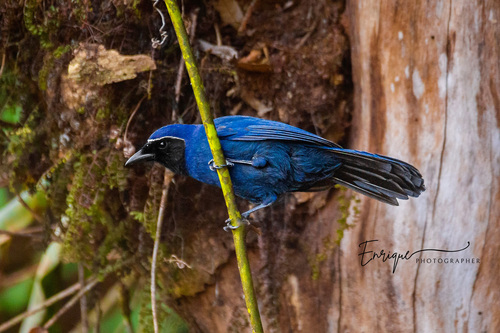
Black-throated Jay
Cyanolyca pumilo
A resident of the misty highlands, the Black-throated Jay is a striking vision in violet and black. This intelligent forest sentinel brings a splash of deep color to the cloud forests of Central America.
Quick Identification
Size
Length of 25-28 cm (10-11 inches); wingspan approximately 35-42 cm (14-16.5 inches); weight ranges from 40-55 g (1.4-1.9 oz)
Colors
Deep violet-blue body and wings; jet-black face mask, throat, and upper breast; distinct silvery-white to light blue forehead band
Key Features
- Solid black 'bib' and face mask
- Silvery-white band across the forehead
- Deep purplish-blue plumage
- Square-ended tail shorter than most jays
When You’ll See Them
Geographic range
Where Does the Black-throated Jay Live?
The Black-throated Jay is a specialized highland species native to the mountain ranges of North and Central America. Its core range is concentrated in the southern Mexican state of Chiapas, extending southward through the rugged interior of Guatemala and into the western parts of Honduras and El Salvador. It is almost exclusively found in temperate or subtropical cloud forest zones and is rarely seen in the tropical lowlands.
Basemap © OpenStreetMap contributors
Behavior
These birds are highly active foragers, spending much of their day investigating bromeliads, moss, and lichen-covered branches for hidden insects. While they are primarily arboreal, they will occasionally descend to the forest floor or garden basins to drink or bathe. Like most jays, they exhibit high levels of curiosity and may investigate new objects in their territory, though they remain cautious of direct human interaction.
EverydayEarth exclusive
Camera Tips
If you are trying to attract them to a backyard station in their native range, use high-energy lures like suet blocks or mealworms. They are particularly fond of textured perches, so mounting your camera near a feeding platform with natural bark or lichen will encourage them to linger longer. Because they are active in the shadows of dense cloud forests, ensure your camera has a high-quality sensor capable of handling low-light conditions to avoid grainy footage.
Set your camera to a fast trigger speed and use burst mode for still photos. Like all corvids, their movements are quick and jerky. For video, a 30-second clip length is ideal, as they often land, survey the area, and feed in short bursts. During the breeding season (typically March through June), you may see them carrying nesting material; placing cameras near dense thickets or epiphytic growth during these months can provide a glimpse into their nesting behavior.
Similar Species
Species that look similar or are commonly confused with Black-throated Jay.
Frequently Asked Questions
Record Black-throated Jay at your habitat
Connect a camera to start building your own species record — AI identifies every visitor automatically.