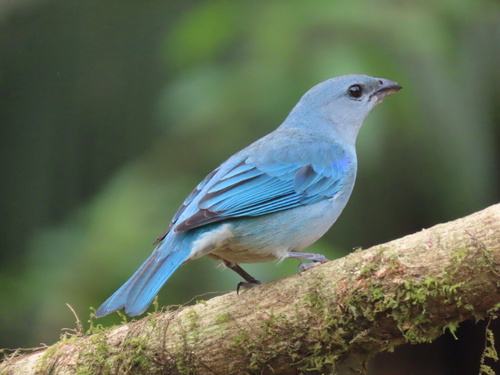
Azure-shouldered Tanager
Thraupis cyanoptera
The Azure-shouldered Tanager is a vibrant jewel of the Brazilian Atlantic Forest, easily identified by its shimmering blue 'epaulets.' This adaptable songbird brings a splash of coastal color to forest edges and garden feeders alike.
Quick Identification
Size
17.5–19 cm (6.9–7.5 in) in length; weighs 37–48 g (1.3–1.7 oz)
Colors
Dull blue-gray body with vibrant azure-blue patches on the shoulders (lesser coverts); dark wings and tail with greenish-blue edges
Key Features
- Distinct bright azure shoulder patches
- Chunky, dark finch-like beak
- Uniform grayish-blue plumage on head and breast
- Dark primary feathers with subtle blue-green edging
When You’ll See Them
Geographic range
Where Does the Azure-shouldered Tanager Live?
This species is a specialist of the South American Atlantic Forest, found exclusively in southeastern Brazil. Its range extends from the coastal forests of southern Bahia and Espírito Santo down through the mountains of Minas Gerais and São Paulo, reaching as far south as northern Rio Grande do Sul. It thrives in the mist-belt of the coastal mountains, favoring humid environments over drier inland scrub.
Basemap © OpenStreetMap contributors
Behavior
Azure-shouldered Tanagers are highly social and energetic birds, typically seen in pairs or small family groups. They are active participants in mixed-species foraging flocks, often seen moving through the canopy alongside other tanagers, honeycreepers, and wood-warblers. While they are primarily canopy dwellers, they are bold enough to descend to the forest edge or into suburban gardens when tempted by fruiting trees or feeders.
These birds are quite vocal, maintaining contact with their group through a series of high-pitched, metallic chirps. They exhibit a restless foraging style, hopping quickly between branches to glean insects from leaves or to pluck small berries. Despite the ongoing habitat loss in their native range, they have shown a remarkable ability to adapt to secondary growth and human-altered landscapes, provided there is sufficient canopy cover and food.
EverydayEarth exclusive
Camera Tips
To capture high-quality footage of the Azure-shouldered Tanager, focus your efforts on water and fruit. These birds are frequent bathers, especially during the humid summer months. Place your camera about 4-6 feet high, pointed at a shallow bird bath or a natural tree hollow that collects water. A trickling water feature or 'dripper' is particularly effective at catching their attention from the canopy.
If you are using a feeder to attract them, choose a platform style rather than a tube feeder. They are very fond of soft fruits like papaya, overripe bananas, and halved oranges. Mount your camera on a nearby branch or a dedicated tripod at eye level with the feeder. Because their blue plumage can look dull in deep shade, try to position the setup where it receives bright, indirect morning light to make those azure shoulder patches pop in the frame.
Set your camera to a fast trigger speed and use a burst mode (3-5 photos). Tanagers are notoriously flighty and rarely sit still for long while feeding. A high-sensitivity PIR sensor setting is recommended to ensure the camera triggers the moment they land. If your camera supports video, short 10-second clips are excellent for capturing their social interactions and vocalizations.
Similar Species
Species that look similar or are commonly confused with Azure-shouldered Tanager.
Sayaca Tanager
Lacks the brilliant azure shoulder patch; has a more uniform, pale grayish-blue or greenish-blue plumage.
Golden-chevroned Tanager
Very similar in body shape and color but features a bright yellow shoulder patch instead of blue.
Palm Tanager
Duller olive-gray plumage with a distinct pale wing bar and no blue shoulder patches.
Frequently Asked Questions
Record Azure-shouldered Tanager at your habitat
Connect a camera to start building your own species record — AI identifies every visitor automatically.