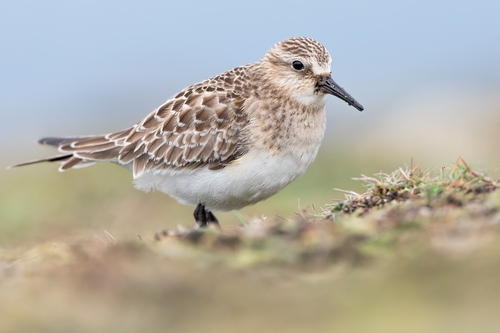
Baird's Sandpiper
Calidris bairdii
A champion of the skies, Baird's Sandpiper travels from the Arctic Circle to the tip of Patagonia. Look for its distinctively long wings and 'scaly' back as it pauses on its epic 9,000-mile journey.
Quick Identification
Size
Length of 17–19 cm (6.7–7.5 in), wingspan of 38–41 cm (15–16 in), and weight between 35–65 g (1.2–2.3 oz)
Colors
Buff-brown upperparts with a distinct scaly pattern; white underparts with a finely streaked buffy breast; black legs and a straight black bill.
Key Features
- Extra-long wings that extend well past the tail tip at rest
- Distinct 'scaly' appearance on the back caused by pale feather edges
- Small, thin, straight black bill
- Horizontal posture compared to other shorebirds
When You’ll See Them
Geographic range
Where Does the Baird's Sandpiper Live?
Baird's Sandpiper is a native of the Western Hemisphere with a vast longitudinal reach. It breeds in the high Arctic tundra across northern Russia, Alaska, and Canada. During the non-breeding season, it undertakes a massive migration through the interior of North America and Central America to reach its wintering grounds in the Andes Mountains and the southernmost tip of South America, including Argentina and Chile.
Basemap © OpenStreetMap contributors
Behavior
Baird's Sandpipers are renowned as one of the world’s most impressive long-distance migrants, traveling roughly 15,000 kilometers twice a year. Unlike many of their shorebird relatives that prefer deep mud, Baird’s are often found in drier areas such as upper beach ridges, grassy edges, and even mountain meadows. They are typically seen alone or in small groups rather than massive flocks, maintaining a somewhat more solitary and 'quiet' demeanor while foraging.
When feeding, they exhibit a rapid-fire pecking motion, moving quickly across the ground to snatch up insects. They are notably less skittish than other small sandpipers, sometimes allowing observers to get relatively close. During their migration through the interior of the Americas, they rely heavily on ephemeral wetlands and rain-filled puddles in agricultural fields as vital pit stops.
EverydayEarth exclusive
Camera Tips
To capture high-quality footage of a Baird's Sandpiper, place your camera at a very low angle, ideally just a few inches off the ground. These birds spend their time foraging on flat surfaces, and a low perspective provides a much more intimate, professional look than shooting from above. Focus on the transition zones where mud meets dry grass or the upper debris line of a beach, as they prefer these slightly drier spots over standing water.
Because these sandpipers move with a quick, nervous energy, use a fast shutter speed (at least 1/1000s if your camera allows manual settings) or a high-frame-rate video mode (60fps or higher). This will help you freeze their rapid pecking motions and sharp wing movements. If you are using an AI-triggered camera, ensure the sensitivity is set to high, as their small size and earth-toned plumage can sometimes blend into the background, making detection difficult.
Lighting is crucial; the 'golden hours' of early morning and late afternoon will highlight the beautiful scaly texture of their feathers. Avoid placing cameras where they will face directly into a midday sun, as the reflection off wet mud or sand can blow out the highlights on the bird’s white underparts. No bait is usually required, but placing the camera near a receding puddle after a rainstorm in late August is a surefire way to catch migrants stopping for a drink and a bath.
Similar Species
Species that look similar or are commonly confused with Baird's Sandpiper.
White-rumped Sandpiper
Almost identical in shape, but has a bright white rump patch visible in flight and a more streaked flank.
Least Sandpiper
Much smaller with yellowish legs, whereas Baird's has black legs.
Pectoral Sandpiper
Larger with a very sharp 'cutoff' between its heavily streaked breast and white belly, and typically has yellowish-green legs.
Frequently Asked Questions
Record Baird's Sandpiper at your habitat
Connect a camera to start building your own species record — AI identifies every visitor automatically.