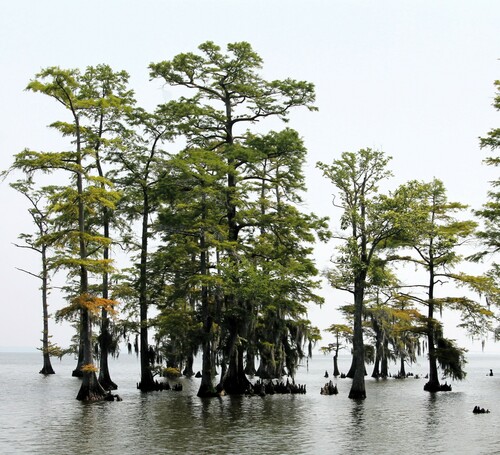
baldcypress
Taxodium distichum
A prehistoric sentinel of the American South, the baldcypress is a rare deciduous conifer famous for its moss-draped branches and mysterious woody 'knees.' Whether standing in a misty swamp or a sun-drenched backyard, it offers a stunning transformation from feathery summer greens to coppery autumn reds.
Quick Identification
Size
Height of 25–40 m (80–130 ft) and a trunk diameter of 1–3 m (3–10 ft)
Colors
Soft green needles in summer; copper, cinnamon-brown, or russet-red in autumn; silvery-gray to reddish-brown fibrous bark
Key Features
- Feathery, flat, two-ranked needles that drop in winter
- Distinctive woody 'knees' (pneumatophores) growing from roots
- Flared, buttressed trunk base on mature specimens
- Small, round, woody seed cones that turn from green to brown
When You’ll See Them
Geographic range
Where Does the baldcypress Live?
The baldcypress is a quintessential icon of the Southeastern United States, naturally occurring from the Atlantic Coastal Plain in Delaware down through the Florida peninsula. Its range extends westward along the Gulf Coast into Texas and reaches deep into the interior along the Mississippi River valley as far north as southern Illinois and Indiana. While its heartland is the deep South, it has been successfully planted as a hardy ornamental tree across much of temperate North America and parts of Europe and Asia.
Basemap © OpenStreetMap contributors
Behavior
The baldcypress is a long-lived, deciduous conifer that plays a vital role in its ecosystem. Unlike most conifers that stay green all year, this species sheds its needle-like leaves every autumn, earning it the name 'bald.' In its natural swampy habitat, it is famous for producing 'knees'—woody projections that grow from the root system above the water level. While scientists still debate their exact purpose, they likely provide structural stability in soft, muddy soils and may assist in oxygenating the root system.
In a backyard or park setting, the baldcypress is a majestic 'social' tree, often serving as a primary nesting site for various birds. It is incredibly hardy and can live for over 600 years, with some specimens in the wild reaching ages of over 1,500 years. It interacts with humans primarily as a popular ornamental and shade tree, valued for its ability to grow in both standing water and dry upland soils, as well as its high resistance to rot and insect damage.
EverydayEarth exclusive
Camera Tips
Capturing the majesty of a baldcypress on camera requires a focus on its unique architectural features. To showcase the iconic 'knees' and the buttressed trunk, place your camera at a low angle, roughly 12-18 inches off the ground. If your tree is near water, look for a placement that captures the reflection of the flared trunk during the calm morning hours. Because these trees are often found in dark, swampy, or shaded areas, ensure your camera has a wide aperture setting or use a model with high dynamic range to prevent the dark bark from becoming a silhouette against a bright sky.
One of the best ways to document a baldcypress is through time-lapse photography. Because it is a deciduous conifer, setting a camera to take a daily photo from the same spot throughout October and November will capture the spectacular color shift from green to russet-red. If you are using a trail camera to monitor wildlife visiting the tree, aim it toward the lower branches or the base; the thick bark and rot-resistant wood attract wood-boring insects, which in turn bring in woodpeckers and nuthatches during the daylight hours.
For those looking to capture animal interactions, the baldcypress is a magnet for birds of prey and waterfowl. If your camera is high-mounted (10-15 feet), point it toward the 'crotches' of large branches where Great Horned Owls or Ospreys may roost. In suburban settings, the base of the tree is a high-traffic area for squirrels and chipmunks gathering the small, resinous cones in late summer. No bait is needed to attract wildlife to a baldcypress; its natural structure provides all the cover and food (in the form of seeds) that local fauna require.
Similar Species
Species that look similar or are commonly confused with baldcypress.
Dawn Redwood
A fellow deciduous conifer, but its needles and branches grow in an opposite (paired) arrangement rather than the alternate (staggered) arrangement of the baldcypress.
Atlantic White Cedar
An evergreen conifer with scale-like leaves that does not lose its foliage in the winter or produce 'knees.'
Frequently Asked Questions
Record baldcypress at your habitat
Connect a camera to start building your own species record — AI identifies every visitor automatically.