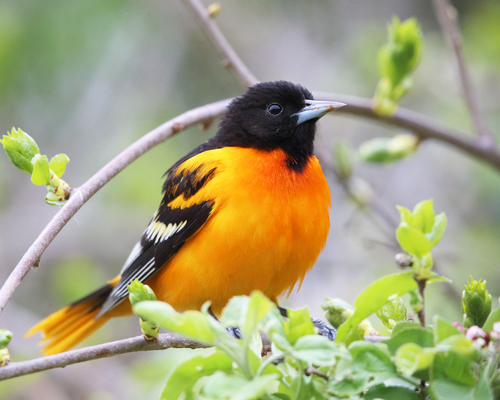
Baltimore Oriole
Icterus galbula
A flash of brilliant flame in the treetops, the Baltimore Oriole is the undisputed jewel of the eastern spring. Known for its rich, flute-like song and remarkable hanging nests, this vibrant visitor is a favorite for backyard birdwatchers.
Quick Identification
Size
Length: 17-22 cm (6.7-8.7 in); Wingspan: 23-32 cm (9-12.6 in); Weight: 30-40 g (1.1-1.4 oz)
Colors
Males feature brilliant flame-orange underparts and rumps with jet-black heads, backs, and wings. Females and immatures are olive-yellow with grayish wings and two white wing bars.
Key Features
- Sharp, silver-gray pointed bill
- Vibrant orange-and-black contrast on males
- Intricately woven, sock-like hanging nests
- Rich, flute-like whistling song
When You’ll See Them
Sightings on EverydayEarth
May 11, 2026
A female or immature male Baltimore Oriole perches on the edge of the jelly tray, taking several bites of the grape jelly while occasionally pausing to look around.
May 10, 2026
A female Baltimore Oriole lands on the feeder, eyeing the orange slices before dipping its bill into the grape jelly for a snack. [This is the first confirmed sighting of Baltimore Oriole, a target species for this habitat. This is a meaningful milestone.]
Jun 13, 2026
A Baltimore Oriole lands directly on the feeder tray and begins foraging. It moves across the tray, tilting its head to inspect the surface for food before hopping closer to the camera.
May 25, 2026
A female Baltimore Oriole lands on the edge of the bird feeder, peering into the tray and investigating the sunflower seeds before hopping down for a closer look.
May 18, 2026
A male Baltimore Oriole is perched on the edge of a red feeder tray, eating grape jelly. It pauses several times to look around, showing its distinctive orange and black plumage.
May 12, 2026
A Baltimore Oriole, likely a female or immature male given the yellow-orange coloration, visits the feeder. It perches on the edge of the orange-themed feeder and feeds on grape jelly from one of the wells, occasionally looking directly into the camera lens.
Geographic range
Where Does the Baltimore Oriole Live?
Native to the Americas, the Baltimore Oriole is a classic neotropical migrant. During the spring and summer breeding season, its core range extends across the eastern and central United States and into southern Canada, reaching as far west as the Great Plains. As autumn approaches, these birds journey south to their wintering grounds, which stretch from Florida and the Caribbean through Mexico and Central America, reaching the northernmost regions of South America.
Basemap © OpenStreetMap contributors
Recorded on EverydayEarth
Behavior
Baltimore Orioles are acrobatic foragers known for their preference for the high canopy of deciduous trees. While they are often heard before they are seen, their rich, fluting whistles are a hallmark of spring in eastern North America. They are famous for their unique 'gaping' feeding technique, where they insert their closed bill into soft fruit or blossoms and then open it to create a channel for the sweet juices to flow.
These birds are master architects, with females spending up to a week weaving pendulous, pouch-shaped nests from slender fibers like grass, horsehair, or even twine. Despite their bright colors, they can be somewhat shy around humans, preferring to stay hidden in the foliage unless lured by specific backyard offerings like oranges or grape jelly.
EverydayEarth exclusive
Camera Tips
To capture stunning footage of Baltimore Orioles, your best bet is to set up your camera near a specialized oriole feeder. Unlike many backyard birds, these visitors are highly attracted to bright colors and specific 'treats.' Mount your camera at eye level (about 5-6 feet) focused on a platform that holds orange halves or a small dish of grape jelly. The bright orange of the fruit acts as a natural visual lure that looks fantastic on camera.
Because orioles are incredibly fast and flutter their wings frequently while feeding, use a high shutter speed or a 'burst' mode if your camera supports it. If you are using an AI-powered camera, place it in a spot with dappled sunlight rather than harsh, direct midday sun; the intense orange feathers can easily 'blow out' or lose detail in high-contrast lighting. Early morning light provides a warm glow that perfectly complements their plumage.
Consider the timing: Baltimore Orioles are some of the earliest migrants to leave in late summer. In many northern states, your best window for camera activity is from early May through July. If you have a birdbath, keep it shallow and clean; orioles are frequent bathers and providing a moving water feature or a dripper can result in some of the most entertaining 'action' shots of the season.
Similar Species
Species that look similar or are commonly confused with Baltimore Oriole.
Bullock's Oriole
The western counterpart; males have an orange face with a black eye-line, unlike the solid black head of the Baltimore.
Orchard Oriole
Smaller and slimmer; the male is a deep, burnt-chestnut color rather than bright flame-orange.
Scarlet Tanager
While also bright, the tanager is a deep blood-red with black wings and has a much thicker, stubbier beak.
Frequently Asked Questions
Record Baltimore Oriole at your habitat
Connect a camera to start building your own species record — AI identifies every visitor automatically.