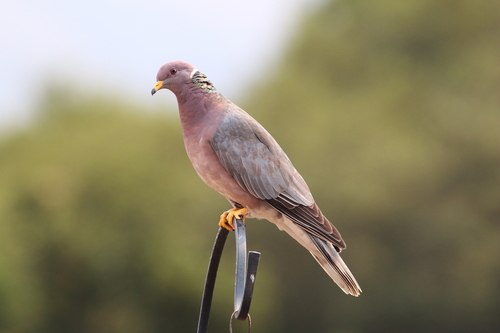
Band-tailed Pigeon
Patagioenas fasciata
A majestic forest dweller of the West, the Band-tailed Pigeon is easily recognized by its distinctive white collar and bright yellow beak. Favoring high canopies and oak-studded slopes, this large wild pigeon brings a touch of mountain wilderness to suburban backyards.
Quick Identification
Size
Length: 33-40 cm (13-16 in); Wingspan: 66 cm (26 in); Weight: 250-450 g (8.8-15.9 oz)
Colors
Soft blue-gray upperparts and purplish-gray underparts; iridescent green patch on the hindneck; white collar on the nape; yellow bill with a black tip; yellow feet.
Key Features
- Thin white 'collar' crescent on the back of the neck
- Bright yellow bill with a black tip
- Wide, pale gray terminal band on a rounded tail
- Yellow legs and feet contrast with gray body
When You’ll See Them
Sightings on EverydayEarth
Jun 20, 2026
Two Band-tailed Pigeons are visiting the feeder station; one perches directly on top of the suet cage to feed while another searches for seeds on the ground below. To the left, a Mexican Jay perches on a branch, observing the area before briefly flicking its tail.
May 15, 2026
A high-activity morning scene featuring several species of columbids. A White-winged Dove lands on the left-side tube feeder, displaying its namesake wing markings, while a Mourning Dove rests on the lower platform. Meanwhile, a Band-tailed Pigeon remains stationary on the top crossbar of the wooden feeder structure.
Geographic range
Where Does the Band-tailed Pigeon Live?
Native to the Western Hemisphere, the Band-tailed Pigeon is a quintessential species of the montane West. In North America, its range extends from the lush coastal forests of British Columbia down through the Pacific Northwest and California into the mountain ranges of the Southwest and Mexico. Further south, populations thrive throughout Central America and follow the Andean mountain chain into South America, reaching as far as Peru and northwestern Argentina. While they are primarily residents in the southern parts of their range, northern populations are known to migrate or move nomadically in search of seasonal food crops.
Basemap © OpenStreetMap contributors
Behavior
Band-tailed Pigeons are social birds often found in large, nomadic flocks, sometimes numbering in the hundreds outside of the breeding season. Unlike the common Rock Pigeon found in city centers, these are forest dwellers that spend much of their time high in the canopy. They are famous for their acrobatic feeding style, often hanging upside down to reach berries or acorns at the tips of branches. When they take flight, their wings produce a loud, rhythmic clapping sound that can be heard from a distance.
These pigeons are quite wary of humans compared to their urban relatives, but they are increasingly frequenting suburban backyards that offer mature trees and reliable food sources. They have a distinctive, low-pitched 'whoo-hoo' call that sounds remarkably similar to a Great Horned Owl, which often confuses novice birdwatchers. They are also known to travel long distances daily between their roosting sites in the mountains and their feeding grounds in the valleys.
EverydayEarth exclusive
Camera Tips
To capture the Band-tailed Pigeon on your backyard camera, focus on water and minerals. Unlike many birds, these pigeons require significant amounts of water to digest their dry diet of acorns and seeds. A large, elevated bird bath or a ground-level water feature with a slow drip is a magnet for them. Position your camera about 3 to 5 feet away from the water source at a slightly downward angle to capture the iridescent green on their neck and their bright yellow feet as they land.
These birds have a unique biological need for minerals and salts, often visiting 'mineral licks.' In a backyard setting, they are frequently attracted to large platform feeders stocked with cracked corn or whole peanuts. Because they travel in flocks, a wide-angle lens or a camera positioned further back is better than a tight zoom, as you'll often get 10 to 20 birds landing simultaneously, creating a spectacular scene of movement and color.
Lighting is crucial for this species. To really see that famous white collar and the purple sheen of their breast, place your camera in a spot that receives bright, indirect morning light. Early morning, shortly after sunrise, is their peak activity time. If you live in an area with oak trees, look for the 'scout' birds that land on the highest dead branches of a tree before the whole flock descends; placing a trail cam on a high vantage point overlooking these staging areas can result in stunning flight shots.
Similar Species
Species that look similar or are commonly confused with Band-tailed Pigeon.
Frequently Asked Questions
Record Band-tailed Pigeon at your habitat
Connect a camera to start building your own species record — AI identifies every visitor automatically.