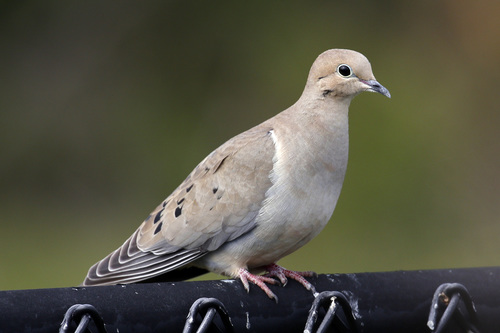
Mourning Dove
Zenaida macroura
Famous for their soulful, rhythmic cooing and elegant pointed tails, Mourning Doves are one of North America’s most frequent and beloved backyard visitors. These peaceful ground-feeders bring a sense of calm and a flash of whistling wings to any camera setup.
Quick Identification
Size
23–34 cm (9–13 in) long; 37–45 cm (15–18 in) wingspan; 96–170 g (3.4–6.0 oz)
Colors
Soft grayish-brown or tan overall with buff-colored undersides. Notable black spots on the wings and a distinctive black crescent-shaped spot below the eye. Males feature iridescent pink or purple patches on the sides of the neck and a bluish crown.
Key Features
- Long, tapered, pointed tail with white outer feathers
- Small, rounded head and slender neck
- Distinctive whistling sound produced by wings during takeoff
- Black spots on wings and behind the eye
When You’ll See Them
Sightings on EverydayEarth
Aug 2, 2026
A busy scene at the feeders with several species present at once. A Mourning Dove feeds calmly in the central tray while a Downy Woodpecker works on the suet feeder to the left. On the right side, multiple male Red-winged Blackbirds and a Brown-headed Cowbird take turns at the tube feeder, with frequent flying and hopping as they compete for space.
Aug 2, 2026
An active early morning at the feeders. A male Downy Woodpecker is perched on the suet log to the left, while a Mourning Dove feeds on the tray below. In the background, a Black-capped Chickadee flits onto a tube feeder to grab a seed.
Jul 30, 2026
A busy summer afternoon at the feeders features four different species feeding simultaneously. A Red-bellied Woodpecker works on a suet block on the left, while a Mourning Dove, a male Red-winged Blackbird, and a Blue Jay occupy the main feeder tray. The Blue Jay flies off early in the clip, but the other three remain to feed in the bright, dappled sunlight.
Jul 29, 2026
A busy scene at the feeders in Sapsucker Woods. A Mourning Dove sits calmly on the main tray while a Downy Woodpecker feeds on suet. Several Red-winged Blackbirds are active, with one showing its bright red shoulder patches on the right tube feeder, and another landing on the left side of the tray late in the clip. A Song Sparrow is also busy at a smaller mesh feeder.
Jul 28, 2026
A busy scene at the bird feeders with several male Red-winged Blackbirds and a Mourning Dove. The blackbirds are very active, landing on the tube, suet, and platform feeders to feed. One Mourning Dove occupies the center of the platform tray, calmly picking through seeds while the blackbirds move around it.
Jul 27, 2026
A Mourning Dove sits quietly on the right side of the tray feeder while three European Starlings forage actively for seeds around it. The starlings exhibit their typical busy feeding behavior, hopping and pecking through the mixed seed.
Geographic range
Where Does the Mourning Dove Live?
The Mourning Dove is native across the North American continent, with a vast range that extends from southern Canada through the entire United States into Mexico and Central America. While many populations in the southern U.S. and Mexico are year-round residents, those breeding in the northernmost parts of the range are migratory, traveling south in large flocks for the winter. They have also successfully established populations in the Caribbean and have been introduced to the Hawaiian Islands.
Basemap © OpenStreetMap contributors
Recorded on EverydayEarth
Behavior
Mourning Doves are gentle, ground-foraging birds often seen in pairs or small groups. They are best known for their rhythmic, mournful "coo-OO-oo-oo" call, which is frequently mistaken for the hooting of an owl. These birds are prolific breeders, capable of raising up to six broods a year in warmer climates, which helps sustain their population despite being a common prey species and popular gamebird.
In the backyard, they are relatively peaceful but can be quite skittish. When startled, their wings produce a sharp, high-pitched whistling sound—a form of non-vocal communication called sonation that alerts other doves to potential danger. They are often seen sunbathing on flat surfaces or dust-bathing to maintain their plumage.
EverydayEarth exclusive
Camera Tips
To capture the best footage of Mourning Doves, place your AI camera at ground level or near a low platform feeder. These birds are strictly ground feeders and rarely use hanging tube feeders. Position the camera about 6 to 12 inches off the ground, facing a patch of bare dirt or short grass where you have scattered white proso millet, cracked corn, or sunflower seeds.
Mourning Doves are most active during the 'golden hours' of early morning and late afternoon. Because they are cautious, try to mount your camera in a fixed, sturdy position; any sudden movement of the camera housing can cause the birds to flush. If your camera allows for burst mode or high-frame-rate video, use it to capture their explosive take-offs, which reveal the beautiful white tips of their tail feathers.
Water is a major draw for this species. Unlike most birds that sip and then tilt their heads back to swallow, Mourning Doves can suck up water without moving their heads. Placing your camera near a ground-level birdbath or a shallow water tray will provide unique behavioral shots of them drinking, which they often do in pairs before dusk.
Similar Species
Species that look similar or are commonly confused with Mourning Dove.
Eurasian Collared-Dove
Larger and heavier with a squared-off tail and a prominent black ring on the back of the neck.
White-winged Dove
Distinguished by a bold white stripe on the wing and a rounded tail rather than a pointed one.
Rock Pigeon
Much larger and stockier with variable plumage, typically featuring iridescent green/purple neck feathers and a dark bill.
Frequently Asked Questions
Record Mourning Dove at your habitat
Connect a camera to start building your own species record — AI identifies every visitor automatically.