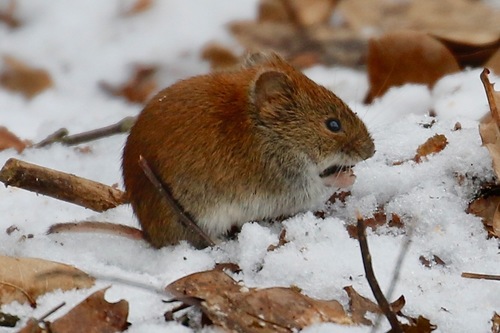
Bank Vole
Clethrionomys glareolus
With its warm chestnut fur and surprisingly bold personality, the Bank Vole is the woodland's most charismatic climber. Often seen darting through leaf litter or scaling low branches, this energetic rodent is a favorite for backyard camera enthusiasts.
Quick Identification
Size
Head and body length 80–120 mm (3.1–4.7 in); tail length 35–72 mm (1.4–2.8 in); weight 14–40 g (0.5–1.4 oz)
Colors
Distinctive reddish-brown or chestnut fur on the back with greyish-white flanks and belly; tail is dark on top and pale underneath
Key Features
- Rich reddish-brown fur on the upper parts
- Blunt, rounded muzzle and small ears
- Tail is approximately half the length of the head and body
- Active, quick movements with significant climbing ability
When You’ll See Them
Geographic range
Where Does the Bank Vole Live?
The Bank Vole is native to a vast stretch of the Palearctic, spanning from Western Europe across to northwestern Asia and parts of Siberia. It is a widespread resident across the mainland of Great Britain, thriving in almost any area with sufficient woodland or hedge cover. While it was not originally native to Ireland, it was accidentally introduced in the mid-20th century and has since established a significant and expanding population across the south and southwest of the country.
Basemap © OpenStreetMap contributors
Behavior
Bank Voles are energetic and inquisitive rodents that, unlike many other vole species, are excellent climbers. They are frequently observed scurrying along low-hanging branches or moving through the undergrowth with surprising speed. While they are active throughout a 24-hour cycle, they follow a polyphasic rhythm, alternating short periods of intense activity with rest. This makes them one of the easier small mammals to spot during daylight hours, especially in the dappled light of a woodland floor.
Socially, Bank Voles are somewhat territorial, especially females during the breeding season. They live in shallow burrow systems often situated under leaf litter, tree roots, or logs. Their presence is often given away by small, neat holes in the ground or 'runways'—tiny cleared paths through the grass. Unlike the more timid Field Vole, Bank Voles are relatively bold and will often venture into the open if they feel there is enough cover nearby to retreat to in case of danger.
EverydayEarth exclusive
Camera Tips
To capture the Bank Vole on camera, focus your efforts on 'edge' habitats where woodland meets a garden or clearing. Place your camera at ground level, ideally near a woodpile, stone wall, or thick hedge. Because these voles are so small, you should set your camera to its closest focusing distance or use a macro lens attachment if available. Position the lens about 30-50 cm (12-20 inches) away from a known 'runway' or a suspected burrow entrance under a log.
Baiting is highly effective for Bank Voles. A small heap of wild bird seed, crushed hazelnuts, or a smear of peanut butter on a rock will keep them in the frame long enough for a clear shot. Since they are fast movers, use a high-speed trigger setting and, if your camera allows, a burst mode of 3-5 photos per trigger. This ensures you catch them in a still moment rather than as a brown blur.
Lighting is key for capturing their chestnut color. If your camera has a 'no-glow' IR flash, it won't startle them at night, but some of the best footage will come during the day. Look for spots where sunlight filters through the canopy; the contrast can be tricky, so try to angle the camera to avoid direct glare. In autumn, leave some fallen leaves in the frame—Bank Voles love to forage through leaf litter, and the sound of rustling can sometimes help you time your observations.
Similar Species
Species that look similar or are commonly confused with Bank Vole.
Frequently Asked Questions
Record Bank Vole at your habitat
Connect a camera to start building your own species record — AI identifies every visitor automatically.