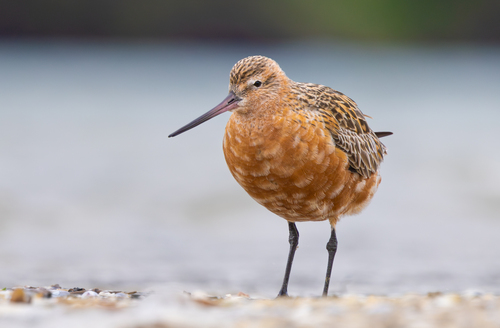
Bar-tailed Godwit
Limosa lapponica
Meet the world's most impressive long-distance traveler. The Bar-tailed Godwit can fly non-stop for over 11,000 kilometers, linking the Alaskan tundra to the beaches of New Zealand in a single, heroic flight.
Quick Identification
Size
Length: 37–41 cm (14.5–16 in); Wingspan: 70–80 cm (27.5–31.5 in); Weight: 250–630g (8.8–22.2 oz)
Colors
Mottled brown and grey in winter; males turn deep brick-red on the neck and underparts during breeding; tail has fine black and white horizontal bars.
Key Features
- Long, bi-colored bill with a slight upward curve
- Barred black-and-white tail pattern
- No white wing-bars in flight
- Long, dark blue-grey legs
- Deep red breeding plumage in males
When You’ll See Them
Geographic range
Where Does the Bar-tailed Godwit Live?
Native to the northernmost reaches of the globe, the Bar-tailed Godwit breeds across the Arctic tundra from Northern Europe and Russia to Alaska. During the non-breeding season, they undergo spectacular migrations to reach the coastal estuaries of Australia, New Zealand, and parts of Africa and Southeast Asia. They are most commonly spotted by coastal residents in the Southern Hemisphere between September and March before they begin their grueling journey back to the Northern Hemisphere.
Basemap © OpenStreetMap contributors
Behavior
The Bar-tailed Godwit is a champion of the avian world, best known for its record-breaking non-stop migrations. These birds are highly social and are typically found in large flocks, often numbering in the thousands, especially during the non-breeding season. They are remarkably focused foragers, spending hours following the ebb and flow of the tide to probe deep into the mud for food.
While they are wary of human presence, they can become accustomed to people in areas where they are not hunted. Their life revolves around the lunar cycle and tidal movements rather than a strict daylight schedule. On their wintering grounds in Australia and New Zealand, they spend their days and nights moving between roosting sites and feeding grounds, driven by the rhythmic uncovering of the intertidal flats.
EverydayEarth exclusive
Camera Tips
Capturing a Bar-tailed Godwit on camera requires understanding the local tide table. These birds are best photographed at high-tide roosts where they gather in large numbers to wait for the water to recede. Place your camera on a low-profile ground stake or sand-anchor at the edge of the high-tide line. Angle the camera slightly upward to capture the reflection of the sky and the water, which creates a stunning professional look for wading bird photography.
Because these birds are sensitive to movement, a stationary trail camera or an AI-powered backyard camera located near a coastal property is ideal. You don't need bait—their lure is the mud itself. If you are on a coastal property, focus your camera on a flat, muddy patch that stays wet. This is where they will probe for worms. Use a fast shutter speed setting if available, as their bill movement while probing is incredibly rapid and can cause motion blur in low light.
Lighting is crucial for bringing out the intricate 'bars' on the tail and the rich brick-red of the breeding male. Set your camera to capture high-resolution video during the golden hours—shortly after sunrise or before sunset. In New Zealand and Australia, the best time to see them in their vibrant breeding plumage is just before they depart in March. Ensure your camera housing is salt-resistant, as the coastal mist can be corrosive to electronics over long periods.
Similar Species
Species that look similar or are commonly confused with Bar-tailed Godwit.
Black-tailed Godwit
Has a straighter bill and a bold white wing-bar that is visible during flight.
Hudsonian Godwit
Features dark underwing coverts and a much more pronounced upward curve to the bill.
Far Eastern Curlew
Significantly larger with a much longer, down-curved bill rather than an up-curved one.
Frequently Asked Questions
Record Bar-tailed Godwit at your habitat
Connect a camera to start building your own species record — AI identifies every visitor automatically.