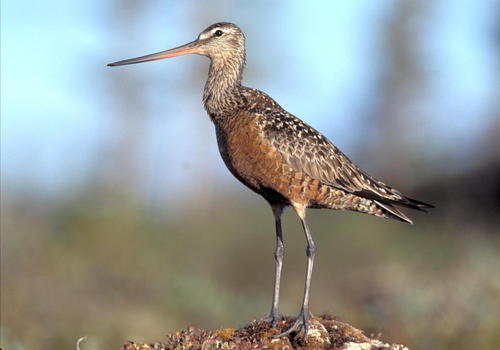
Hudsonian Godwit
Limosa haemastica
A marathon migrant of the shorebird world, the Hudsonian Godwit is famous for its chestnut plumage and its epic 7,000-mile journey from the Arctic to South America.
Quick Identification
Size
Length: 37–42 cm (14.5–16.5 in); Wingspan: 70–80 cm (27.5–31.5 in); Weight: 195–360 g (6.9–12.7 oz)
Colors
Breeding males feature a deep chestnut-red belly with dark barring; females are similar but paler. Both have grey-brown upperparts and a distinctive white rump patch above a black tail.
Key Features
- Long, bi-colored bill slightly upturned at the tip
- Black wing pits (axillars) visible only in flight
- Chestnut-red underparts during breeding season
- White rump contrasting with a solid black tail
When You’ll See Them
Geographic range
Where Does the Hudsonian Godwit Live?
The Hudsonian Godwit is native to the Americas, breeding in three disjunct areas across Alaska and Northern Canada. This extreme migrant travels across the Caribbean and South America to reach its wintering grounds in the Southern Cone, primarily in Argentina and Chile. While they are rarely seen in the interior of the United States, they are occasional visitors to the Great Plains and the Atlantic coast during their incredible trans-continental journeys.
Basemap © OpenStreetMap contributors
Behavior
The Hudsonian Godwit is one of the world’s most incredible long-distance travelers, performing non-stop migratory flights that can span several thousand miles. On their remote breeding grounds in the Arctic, they are known for an unusual behavior for shorebirds: perching on the thin lead shoots of spruce trees to vocalize and keep watch over their territory. Once they begin their southern journey, they become highly gregarious, forming large, tightly knit flocks that rest and feed in unison on coastal mudflats.
Their foraging style is distinctive and energetic, often described as a 'sewing machine' motion. They plunge their long, sensitive bills deep into soft mud or sand, probing rapidly to feel for prey. While they are generally wary of humans and will flush if approached, they are less concerned with stationary objects, making them excellent subjects for well-placed, remote wildlife cameras near their preferred stopover points.
EverydayEarth exclusive
Camera Tips
Capturing a Hudsonian Godwit on camera requires strategic placement near water, as they are unlikely to visit a standard dry backyard. If your property includes a marsh, wetland edge, or a field that floods during spring rains, place your camera on a low-profile tripod or a ground mount. Aiming the camera just a few inches above the mud line provides a dramatic, professional perspective that captures the bird’s reflection and the intricate detail of its upturned bill.
Because these birds are 'probers' that follow the waterline, pay close attention to the receding moisture. Position your camera where the mud is still soft but not fully submerged. You don't need artificial bait; instead, focus on 'natural lures' like shallow puddles or recently tilled, wet soil where invertebrates are closer to the surface. In tidal areas, time your camera checks with the low tide when the mudflats are exposed and feeding activity is at its peak.
High shutter speeds are essential for this species. Their probing 'sewing machine' feeding motion is incredibly fast, and a standard trail camera trigger might result in a blur. Use a 'burst' or 'rapid-fire' photo mode to ensure at least one shot captures the bird with its head up. Since they often travel in flocks, a wide-angle lens setting is preferable to capture the social dynamics of the group rather than just a single individual.
Similar Species
Species that look similar or are commonly confused with Hudsonian Godwit.
Marbled Godwit
Larger and overall more cinnamon-colored, lacking the Hudsonian's distinctive black tail and white rump patch.
Black-tailed Godwit
Very similar, but has white underwing coverts whereas the Hudsonian has distinctive black underwings.
Willet
Has a straight, shorter bill and lacks the chestnut belly, though it shares a bold black-and-white wing pattern in flight.
Frequently Asked Questions
Record Hudsonian Godwit at your habitat
Connect a camera to start building your own species record — AI identifies every visitor automatically.