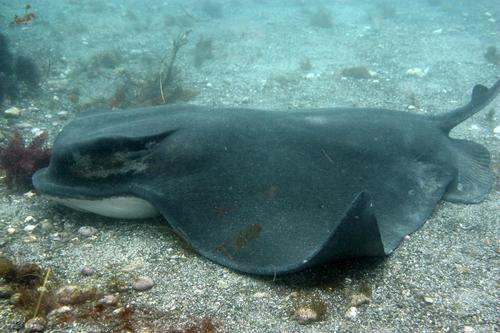
Bat Ray
Myliobatis californica
A majestic 'flyer' of the Pacific coast, the Bat Ray is famous for its bird-like snout and graceful, wing-like fins. Whether gliding through kelp forests or searching for clams in sandy bays, this gentle ray is a coastal icon.
Quick Identification
Size
Wingspan up to 1.8 m (6 ft) and weight up to 91 kg (200 lbs)
Colors
Uniformly dark brown to black on the dorsal side; creamy white or pale ventral side
Key Features
- Wing-like pectoral fins with pointed tips
- Broad, raised head with a blunt 'duck-bill' snout
- Whip-like tail featuring a venomous spine at the base
- Distinctive indentation between the eyes
When You’ll See Them
Sightings on EverydayEarth
Aug 1, 2026
A Blacktip Reef Shark swims gracefully across the foreground, passing a small artificial reef structure. A Zebra Shark is seen resting on the sandy bottom in the mid-ground, while a Bat Ray and several smaller fish move through the background of the sun-dappled lagoon.
Aug 1, 2026
In the foreground, an adult Zebra Shark rests calmly on the sandy floor next to a vibrant artificial reef structure. A Bat Ray glides across the background from right to left, while several smaller unidentified fish swim through the mid-ground. The scene is a serene view of life within a marine lagoon environment.
Aug 1, 2026
A dynamic underwater scene in a shark lagoon. A Blacktip Reef Shark swims through the center of the water column, moving from right to left. Below it, a Zebra Shark rests stationary on the sandy floor near a colorful coral and sponge outcrop. To the right, a Bat Ray glides through the water, while several small reef fish dart around the artificial reef structures in the foreground and background.
Aug 1, 2026
The lagoon is teeming with activity. A leopard shark with prominent dark spots swims across the foreground, while a large bat ray glides gracefully along the sandy bottom on the left. Several smaller fish, including a California sheephead, are seen navigating around the artificial reef structures in the center of the frame.
Aug 1, 2026
In the dim light of the lagoon, a Leopard Shark glides through the upper water column while a Bat Ray cruises slowly along the sandy bottom on the far left. Several small fish dart between the coral formations and across the center of the frame.
Jul 31, 2026
In a peaceful underwater scene, a Leopard Shark rests on the sandy floor near a coral outcropping. A variety of fish, including a male California Sheephead with its signature pink and black coloring, swim through the water column. On the far left, a Bat Ray glides gracefully past the camera.
Geographic range
Where Does the Bat Ray Live?
The Bat Ray is a signature species of the Eastern Pacific Ocean, native to the coastal waters of North America. Its primary range stretches from the temperate shores of Oregon in the United States, down through the entire length of California, and extending into the warm waters of the Gulf of California in Mexico. They are particularly common in protected inland bays and lagoons, where the shallow, nutrient-rich waters provide ideal nurseries for their young.
Basemap © OpenStreetMap contributors
Behavior
Bat Rays are highly graceful swimmers that appear to 'fly' through the water by flapping their massive, wing-like pectoral fins. Unlike many of their stingray relatives that spend most of their time buried in the sand, Bat Rays are frequently observed cruising through the mid-water column or soaring near the surface of bays and kelp forests. They are social animals and are often found in large schools, sometimes numbering in the hundreds, particularly during the summer mating season.
When it comes to feeding, these rays are the 'excavators' of the seafloor. They use their pectoral fins to flap against the sediment, creating a suction that uncovers buried prey like clams and shrimp. They possess incredibly strong, flat teeth arranged in plates—much like a conveyor belt—that allow them to crush the hardest shells with ease. While they possess a venomous stinger for self-defense, they are generally shy and will choose flight over fight when encountering humans.
EverydayEarth exclusive
Camera Tips
Capturing the Bat Ray on an EverydayEarth setup requires a shift to underwater or dock-side monitoring. If you live on a coastal property or have access to a pier, the most effective method is to mount a waterproof action camera or a dedicated submersible camera to a piling or a weighted tripod. Position the camera about 1 to 3 feet off the bottom, aimed toward sandy clearings or the edges of eelgrass beds, as these are the primary 'flight paths' rays use when foraging for food.
Lighting is the biggest challenge for aquatic wildlife. In shallow water during the day, natural sunlight is usually sufficient, but a polarized filter on your lens is a game-changer if you are filming from above the surface, as it cuts through the water's reflection. For nighttime captures, avoid using a powerful, direct spotlight which can scare the rays; instead, use a wide-angle, diffused red light or a low-intensity LED to capture their nocturnal foraging without causing a flight response.
While you cannot use traditional bait like birdseed, you can attract Bat Rays by placing a perforated PVC pipe filled with crushed mussels or clams near your camera. The scent trail will draw them into the frame to investigate. Set your camera to a high frame rate, such as 60fps, to capture the hypnotic, undulating motion of their wings. This slow-motion footage is particularly effective for AI identification and for observing the unique way they use their snouts to probe the sand.
Similar Species
Species that look similar or are commonly confused with Bat Ray.
Frequently Asked Questions
Record Bat Ray at your habitat
Connect a camera to start building your own species record — AI identifies every visitor automatically.