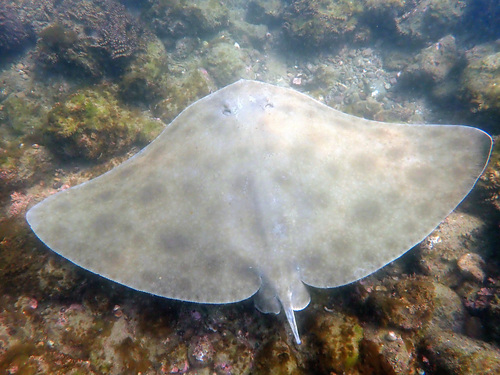
California Butterfly Ray
Gymnura marmorata
With a wingspan that rivals a small bird and a stunning marbled coat, the California Butterfly Ray is the hidden gem of the Pacific shallows. This master of camouflage glides through coastal lagoons, offering a spectacular glimpse into the world of benthic marine life.
Quick Identification
Size
Wingspan typically ranges from 60 to 120 cm (2 to 4 feet), with a weight of 2 to 10 kg (5 to 22 lbs).
Colors
Dorsal surface is grey, brown, or olive with intricate black and light-colored marbling; ventral side is creamy white.
Key Features
- Extraordinarily wide, diamond-shaped body nearly twice as wide as it is long
- Very short, whip-like tail lacking a long stinging spine
- Marbled or spotted camouflage pattern on the back
- Eyes and spiracles located on top of the head for breathing while buried
When You’ll See Them
Geographic range
Where Does the California Butterfly Ray Live?
Native to the eastern Pacific Ocean, the California Butterfly Ray is most frequently encountered along the coast of North America from Point Conception, California, southward. Its range extends through the Gulf of California and along the Central American coastline, reaching as far south as Peru. These rays are particularly fond of protected coastal environments like the many lagoons and shallow bay systems found in Southern California and Mexico.
Basemap © OpenStreetMap contributors
Behavior
The California Butterfly Ray is a master of disguise, spending much of its life partially buried in the sandy or muddy substrates of shallow coastal waters. Unlike many of its relatives, this species has an exceptionally wide, wing-like body that allows it to glide gracefully through the water with a motion that looks more like flying than swimming. When threatened or resting, it uses its pectoral fins to ruffle the sediment, settling into a shallow depression until only its eyes and spiracles are visible.
These rays are generally solitary but can be found in high densities in warm, shallow lagoons and bays, especially during the breeding season. They are not considered aggressive toward humans, and while they belong to the order of stingrays, their tails are so short and their defensive spines so small (or often absent) that they pose very little risk to waders. They are primarily benthic hunters, using their sensitive snouts to detect vibrations and electrical signals from prey hidden beneath the sand.
EverydayEarth exclusive
Camera Tips
Capturing a California Butterfly Ray on camera requires a waterproof setup, ideally positioned in a shallow, sandy-bottomed area during an incoming tide. If you have a dock or a backyard that borders a saltwater lagoon or bay, mounting an underwater action camera to a weighted PVC frame is an effective way to monitor the seafloor. Aim the lens at a slight downward angle toward an open sandy patch near a rock or kelp edge, as rays often patrol these transition zones.
Because these rays are naturally camouflaged, motion-triggering can be difficult underwater. Instead of relying on traditional PIR sensors, use a camera with 'Time Lapse' mode set to take a photo every 5-10 seconds, or use 'Continuous Video' if you have an external power source. Natural light is best, but if you are recording at night, use a dim red light or a specialized underwater infrared illuminator to avoid scaring the fish, as bright white lights may cause them to flee or strike the camera.
To increase your chances of a close-up, you can use a perforated PVC 'bait tube' filled with oily fish like sardines or mackerel, secured about two feet in front of the lens. The scent will draw the ray into the frame, and you may even capture their unique feeding behavior where they use their 'wings' to create suction and pull prey from the sand. Ensure your camera housing is rated for the depth and salt environment, and always rinse it with fresh water after every deployment to prevent corrosion.
Similar Species
Species that look similar or are commonly confused with California Butterfly Ray.
Frequently Asked Questions
Record California Butterfly Ray at your habitat
Connect a camera to start building your own species record — AI identifies every visitor automatically.