Beech Scale
Cryptococcus fagisuga
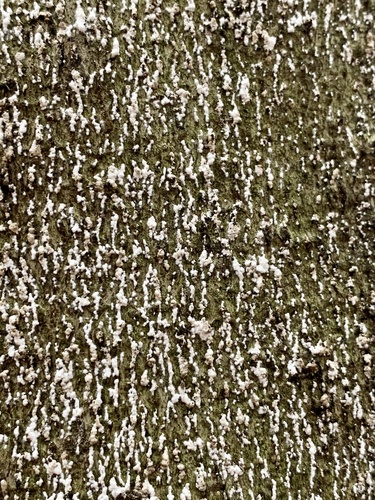
Hidden beneath a blanket of white wax, the Beech Scale is a tiny architect of forest change. While individual insects are nearly invisible, their snowy colonies signal a complex relationship between trees, bugs, and fungi.
Quick Identification
Size
Adults are 0.5–1.0 mm (0.02–0.04 inches) long; colonies appear as large white patches
Colors
Pale yellow bodies, typically hidden under white, waxy, wool-like filaments
Key Features
- White, woolly or felted wax covering on bark
- Found exclusively on beech (Fagus) trees
- Microscopic yellow insects beneath the wax
- Often looks like white paint or snow on the trunk
When You’ll See Them
Geographic range
Where Does the Beech Scale Live?
Native to the temperate forests of Europe, the Beech Scale was introduced to North America in the late 1890s through Nova Scotia. It has since expanded throughout the Eastern United States and Canada, following the distribution of its host trees. Today, it is found from the Maritime Provinces down through the Appalachian Mountains to North Carolina and west into the Great Lakes region.
Basemap © OpenStreetMap contributors
Behavior
The Beech Scale is a sessile insect, meaning that once the female reaches adulthood and finds a feeding spot, she remains stationary for the rest of her life. These insects use long, needle-like mouthparts to pierce the bark of beech trees and reach the nutrient-rich parenchyma cells. As they feed, they secrete a protective white, waxy substance that eventually covers their bodies, giving the appearance of wool or felt on the tree's surface.
These insects reproduce parthenogenetically, meaning females can produce offspring without mating. The life cycle begins with eggs laid under the waxy cover, which hatch into 'crawlers.' These mobile larvae are the only stage that moves, either crawling to new spots on the same tree or being carried by wind and birds to neighboring beeches. While the scale itself causes some stress to the tree, its most significant impact is the creation of entry points for pathogenic fungi.
EverydayEarth exclusive
Camera Tips
Capturing the Beech Scale requires a focus on macro photography and long-term observation rather than high-speed action. Because these insects are stationary, mount your camera on a steady tripod very close to the trunk of an infested beech tree. Using a macro lens or a camera with a high-quality close-up mode is essential to see the individual yellow insects beneath their white 'wool.' Look for deep crevices in the bark or the underside of branches, as these are the scales' favorite hiding spots.
For the best results, avoid filming in direct, harsh sunlight. The white wax is highly reflective and can easily overexpose your image, losing all the fine textural detail. Overcast days provide the soft, even lighting needed to highlight the delicate wax filaments. If you are using a trail camera, set it to a time-lapse mode with high-resolution still images taken once per day. This allows you to track the slow growth of the colonies over a season.
To add more life to your footage, keep the camera rolling to catch the species that interact with the scale. You may capture ladybugs (Coccinellidae) or lacewing larvae predating the scales, or nuthatches and woodpeckers foraging along the bark. These visitors move quickly, so a high frame rate (60fps) is beneficial if your camera supports it. No bait is needed for the scale itself, as they are already anchored to their food source.
Similar Species
Species that look similar or are commonly confused with Beech Scale.
Beech Blight Aphid
Found on twigs and branches rather than the main trunk; they are much larger and move rhythmically when disturbed.
Woolly Apple Aphid
Infests fruit trees rather than beech; often found in clusters on new growth or pruning scars.
Cottony Cushion Scale
Larger, more distinct ribbed egg sacs; primarily infests citrus and woody ornamental plants.
Frequently Asked Questions
Record Beech Scale at your habitat
Connect a camera to start building your own species record — AI identifies every visitor automatically.