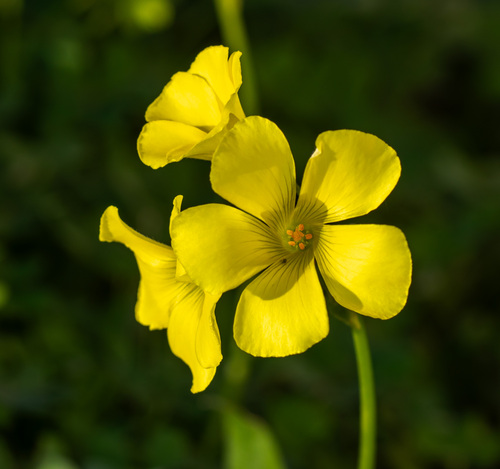
Bermuda buttercup
Oxalis pes-caprae
Transforming backyards into vibrant carpets of gold, the Bermuda buttercup is a master of movement and a sure sign that spring has arrived.
Quick Identification
Size
Height ranges from 10–30 cm (4–12 in); spreads via underground bulbs to cover large areas.
Colors
Brilliant lemon-yellow flowers; trifoliate green leaves often featuring small purple or brown speckles.
Key Features
- Bright yellow funnel-shaped flowers with five petals
- Clover-like green leaves often speckled with dark spots
- Low-growing habit forming dense carpets in sunny areas
When You’ll See Them
Geographic range
Where Does the Bermuda buttercup Live?
Native to the Cape Region of South Africa, the Bermuda buttercup has become a world traveler, establishing itself across every continent except Antarctica. It is most dominant in Mediterranean-style climates, with massive populations blanketing coastal California, the Mediterranean basin, and parts of Southern Australia. Because it thrives in disturbed soil, it is frequently found in residential areas and agricultural lands where human activity has cleared the natural competition.
Basemap © OpenStreetMap contributors
Behavior
Bermuda buttercup is known for its remarkable nyctinasty—a 'sleep' movement where its flowers and leaves fold inward at night or during overcast weather to protect its pollen and reduce moisture loss. During the day, it reacts quickly to sunlight, unfurling its vibrant yellow petals to attract early-season pollinators like small bees and hoverflies.
Unlike many other plants, this species rarely produces viable seeds in its introduced range; instead, it reproduces aggressively through the production of numerous underground bulbils. These small bulbs are easily spread by garden activities, tilling, or burrowing animals, allowing the plant to colonize disturbed soil and garden beds with incredible speed. To humans, it is often viewed as a beautiful but persistent weed that signals the arrival of spring.
EverydayEarth exclusive
Camera Tips
To capture the true beauty of the Bermuda buttercup, place your camera at a very low 'worm’s-eye' view. Setting your lens just a few inches above the ground allows you to look directly into the funnel-shaped flowers, creating a sense of scale and highlighting the delicate speckling on the leaves that is often missed from a standing height.
Because this species exhibits nyctinasty, it is a perfect subject for a daylight-to-nightfall timelapse. Set your camera to capture an image every 5 to 10 minutes from sunrise to sunset. This will reveal the dramatic 'waking up' and 'sleeping' movements as the plant reacts to the shifting light. Ensure your camera is secured to a low stake to prevent wind shake during these long sequences.
Lighting is critical for yellow flowers, which can easily 'blow out' and lose detail in harsh midday sun. Use a macro lens setting if available and try to shoot during the golden hours of late morning or early afternoon when the sun is bright enough for the flowers to be fully open but the light is soft enough to capture the texture of the petals. If using a trail camera, look for a spot that receives mottled sunlight through a tree canopy to create more depth in your photos.
Similar Species
Species that look similar or are commonly confused with Bermuda buttercup.
Frequently Asked Questions
Record Bermuda buttercup at your habitat
Connect a camera to start building your own species record — AI identifies every visitor automatically.