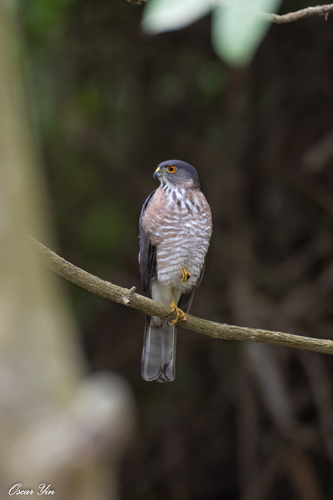
Besra
Tachyspiza virgata
A stealthy ghost of the Asian forests, the Besra is a master of ambush and aerial agility. This small but fierce sparrowhawk brings the raw drama of the wild right to your woodland edge.
Quick Identification
Size
Length: 29-36 cm (11.5-14 in); Wingspan: 50-65 cm (19.5-25.5 in); Weight: 85-220g (3-7.7 oz)
Colors
Males have dark slate-blue upperparts and rufous streaking on the breast; females are larger with brown upperparts and heavy horizontal barring on the belly. Both sexes feature a prominent black vertical stripe on a white throat.
Key Features
- Distinct black vertical 'mesial stripe' on white throat
- Short, rounded wings for agile forest flight
- Long, squared-off tail with dark bands
- Bright yellow eyes and cere (base of beak)
When You’ll See Them
Geographic range
Where Does the Besra Live?
The Besra is native to the vast landscapes of South and Southeast Asia, spanning from the foothills of the Himalayas to the tropical islands of Indonesia. Its core range includes much of India, Sri Lanka, and Southern China, extending down through Myanmar, Thailand, and Vietnam into the Philippines and the Malay Peninsula. While primarily a resident species in tropical zones, some populations in northern latitudes or higher elevations exhibit altitudinal migration or partial movements to warmer climates during the winter months.
Basemap © OpenStreetMap contributors
Behavior
The Besra is a master of the 'sit-and-wait' hunting technique, often spending long periods perched motionless within the dense canopy of forests or woodland edges. Unlike larger raptors that soar high in the sky, this sparrowhawk prefers to stay under the cover of foliage, using its short, rounded wings to navigate through tangled branches with incredible agility. It is a highly secretive bird, making it a prized sighting for backyard observers and trail camera enthusiasts alike.
When it spots a target, the Besra launches a sudden, explosive burst of speed. Its diet primarily consists of smaller songbirds and lizards, which it snatches from mid-air or off branches. While generally solitary, they can be seen in pairs during the breeding season. In suburban settings bordering forests, they may occasionally visit gardens to hunt birds at feeders, though they remain much more cautious than the common Shikra.
EverydayEarth exclusive
Camera Tips
Capturing the Besra on a trail camera requires a strategic approach because of its elusive nature and preference for dense cover. To maximize your chances, mount your camera 5 to 8 feet off the ground, pointing slightly downward toward a known perching spot or a clear flight path near a forest edge. Because they are ambush predators, they often return to the same vantage points; look for 'plucking posts' where feathers on the ground indicate a recent kill site.
Water is a significant draw for these hawks, especially in drier months. Placing a camera near a secluded birdbath or a shallow forest pool can yield spectacular footage of them bathing or drinking. Ensure your camera has a high trigger speed (0.2 seconds or less) to catch their rapid movements, and set it to take a 'burst' of 3-5 photos or a short video clip to document their fascinating behavioral patterns.
While you should never bait raptors with live prey, maintaining a healthy habitat for songbirds will naturally attract Besras to the area. If your camera is in a garden setting, place it at a distance from your bird feeders where the hawk might hide in wait. The best time for activity is during the golden hours of early morning and late afternoon when their prey is most active and the lighting is ideal for high-quality captures.
Similar Species
Species that look similar or are commonly confused with Besra.
Shikra
Lighter pale-grey plumage and lacks the distinct dark vertical throat stripe found on the Besra.
Japanese Sparrowhawk
Slightly smaller with narrower, more delicate barring on the underparts and a thinner throat stripe.
Eurasian Sparrowhawk
Larger overall with longer legs and lacks the specific dark mesial stripe on the throat.
Frequently Asked Questions
Record Besra at your habitat
Connect a camera to start building your own species record — AI identifies every visitor automatically.