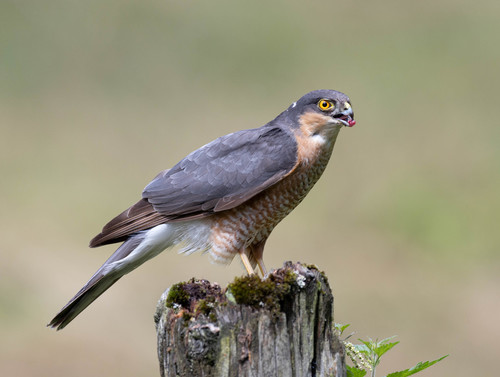
Eurasian Sparrowhawk
Accipiter nisus
The ghost of the garden, the Eurasian Sparrowhawk is a lightning-fast predator that turns every backyard into a high-stakes woodland theater. With its striking yellow eyes and incredible agility, it is the ultimate prize for any backyard wildlife observer.
Quick Identification
Size
Length: 29–41 cm (11–16 in); Wingspan: 59–80 cm (23–31 in); Weight: 110–342 g (3.9–12.1 oz)
Colors
Males have slate-grey backs and rufous (orange) barred chests; females are larger with brown backs and grey-brown barred underparts.
Key Features
- Long, square-ended tail with dark bands
- Short, broad rounded wings for forest agility
- Bright yellow or orange eyes and long yellow legs
- Pronounced size difference with females up to 25% larger than males
When You’ll See Them
Geographic range
Where Does the Eurasian Sparrowhawk Live?
The Eurasian Sparrowhawk is a widely distributed raptor found throughout the temperate and subtropical regions of the Old World. Its native range spans nearly the entire European continent, stretching from the British Isles across Scandinavia and Russia to the Pacific coast of Japan. In the south, it inhabits parts of North Africa and the Middle East, extending through the Himalayas into Southeast Asia. While many populations in Western and Southern Europe are year-round residents, those in the colder northern reaches of Siberia and Northern Europe are migratory, wintering in Africa and Southern Asia.
Basemap © OpenStreetMap contributors
Behavior
The Eurasian Sparrowhawk is a master of the ambush. Unlike hawks that soar high in the open sky, this species is a specialist of the shadows, using cover such as hedges, treelines, and fences to conceal its approach. They are famous for their 'hedge-hopping' flight—a burst of rapid wingbeats followed by a low-level glide—allowing them to surprise prey before it can react. In suburban environments, they have adapted brilliantly, often using the corners of houses or garden sheds as blinds for their high-speed strikes.
While they are solitary hunters, they can be quite bold around human habitation. Their social life is largely centered around the breeding season, where they build platform nests in dense woodland. In the garden, they are often first noticed when songbirds suddenly go silent or scatter. Despite their reputation as fierce predators, they are also vulnerable to larger raptors like Goshawks, which influences their secretive and cautious behavior when not actively hunting.
EverydayEarth exclusive
Camera Tips
To capture a Eurasian Sparrowhawk on your AI-powered camera, you need to think like an ambush predator. Because they don't visit feeders for seeds, you must place your camera where their prey congregates. Position your camera with a wide view of a bird feeder or a bird bath, but ensure the lens is focused on the likely flight paths—usually low-level gaps between bushes or the corners of buildings. A high frame rate (at least 60fps) or a very fast shutter speed is essential; these birds move so quickly that standard 30fps video often results in nothing but a feathered blur.
Consider the 'strike zone.' Sparrowhawks often have a preferred perch nearby where they watch the feeder before attacking. If you see a hawk consistently sitting on a specific fence post or low branch, that is your primary camera spot. Angle the camera slightly downward from a height of 5-7 feet to capture the dramatic moment they pin their prey to the ground. Use high-sensitivity motion triggers, as their transit through the frame can last less than a second.
Seasonality plays a big role in backyard sightings. During winter, when woodland food is scarce, Sparrowhawks frequent gardens much more often. During these months, keep your songbird feeders well-stocked to maintain a consistent 'prey base' that will attract the hawk. If your camera supports 'Pre-Roll' or 'Past Event' recording, enable it; this allows the camera to save the few seconds of footage before the motion was detected, which is often the only way to catch the actual strike rather than just the aftermath.
Similar Species
Species that look similar or are commonly confused with Eurasian Sparrowhawk.
Frequently Asked Questions
Record Eurasian Sparrowhawk at your habitat
Connect a camera to start building your own species record — AI identifies every visitor automatically.