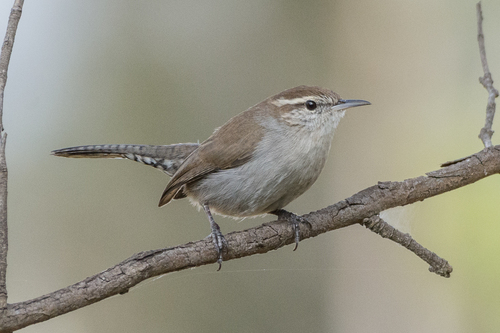
Bewick's Wren
Thryomanes bewickii
With its bold white eyebrow and spirited personality, the Bewick's Wren is a master of the garden thicket. This energetic songbird brings a touch of wild charm to any backyard with its melodic voice and restless tail.
Quick Identification
Size
Length: 12-14 cm (4.7-5.5 in); Wingspan: 18-20 cm (7-11 in); Weight: 8-12 g (0.3-0.4 oz)
Colors
Grey-brown or reddish-brown upperparts, clean white to light grey underparts, and a prominent white stripe above the eye. The tail is long and dark with distinctive white spots on the corners.
Key Features
- Bold white eyebrow (supercilium) extending behind the eye
- Long, slender tail with white-tipped outer feathers
- Slightly down-curved, thin bill
- Frequent jerky, sideways tail-flicking
When You’ll See Them
Sightings on EverydayEarth
Jul 22, 2026
A small Bewick's Wren is seen perched on a horizontal branch on the right side of the large stick nest. It remains stationary for several seconds, looking around its environment, before taking flight and moving out of the frame to the right.
Jul 21, 2026
A Bewick's Wren flies into the frame and lands on the outer sticks of the large eagle nest. It hops quickly between the branches, likely foraging for insects, before moving further into the nest structure.
Jul 21, 2026
A small Bewick's Wren is perched on a branch on the right side of the large stick nest. It remains mostly still, occasionally turning its head to scan the open hillside in the background.
Jul 19, 2026
A small Bewick's Wren flies onto a branch on the right side of the large stick nest. It hops between the branches, looking around and occasionally flicking its tail as it investigates the nest's edge before moving further into the nearby foliage.
Jul 19, 2026
A small Bewick's Wren lands on a branch at the right edge of the large stick nest. It perches for several seconds, observing the area and occasionally flicking its tail before flying away.
Jul 17, 2026
A Bewick's Wren is perched on a protruding stick at the edge of a large stick nest. It remains active throughout the clip, turning its head to scan the surroundings and frequently flicking its tail while maintaining its position.
Geographic range
Where Does the Bewick's Wren Live?
Native to the North American continent, the Bewick's Wren is primarily found across the western United States, throughout Mexico, and into southern British Columbia. While they were historically common in the eastern United States, their range has significantly contracted westward over the last century, making them a rare sight east of the Mississippi. Today, they thrive in the arid scrublands of the Southwest and the humid thickets of the Pacific Coast.
Basemap © OpenStreetMap contributors
Behavior
The Bewick's Wren is a hyperactive and charismatic little bird that rarely stays still for long. It is most easily identified by its long, expressive tail, which it often holds upright or flicks from side to side as it hops through dense brush. These wrens are highly territorial and possess a surprisingly loud, complex song that includes whistles, trills, and gurgles, often sounding like a more musical version of a Song Sparrow.
In the backyard, they are incredibly curious and will explore every nook and cranny of a garden, from flowerpots to woodpiles, in search of food. While they are somewhat shy around direct human movement, they adapt well to suburban environments that provide enough cover. They are solitary foragers during the non-breeding season but maintain strong pair bonds during the spring and summer months.
EverydayEarth exclusive
Camera Tips
To capture the Bewick's Wren on your AI camera, placement is everything. These birds are 'low-zone' specialists, meaning they spend the majority of their time within three feet of the ground. Position your camera at knee-height, facing a brush pile, a dense hedge, or a stack of firewood. Because they are incredibly fast-moving, set your camera to its fastest trigger speed or high-frame-rate video mode to avoid getting nothing but a blurry tail in the shot.
While they don't typically visit traditional seed feeders, you can lure them in using a shallow birdbath or a specialized suet feeder. They are particularly drawn to moving water; a small dripper or solar fountain in a shallow stone basin is a magnet for these wrens. Place the camera 3-5 feet from the water source, ensuring the lens is angled slightly upward if the bath is on a pedestal, or level if it is on the ground.
During the nesting season (March through July), they are frequent users of nest boxes. If you have a birdhouse with a small 1-1/8 inch entrance hole, mount your camera nearby with a clear view of the entrance. Since they are curious about crevices, you can also get great 'investigative' footage by placing a camera near a gap in an old stone wall or a dense trellis where they like to hunt for spiders.
Similar Species
Species that look similar or are commonly confused with Bewick's Wren.
Frequently Asked Questions
Record Bewick's Wren at your habitat
Connect a camera to start building your own species record — AI identifies every visitor automatically.