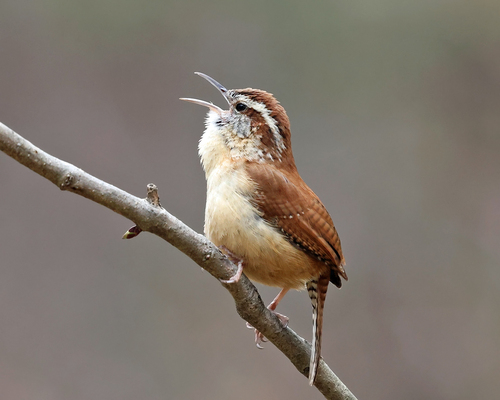
Carolina Wren
Thryothorus ludovicianus
Bold, vocal, and endlessly curious, the Carolina Wren is a pint-sized powerhouse of the eastern woods and backyards. With its signature white eyebrow and jaunty upright tail, this year-round resident brings a big personality and an even bigger song to any garden.
Quick Identification
Size
Length: 12.5–14 cm (4.9–5.5 in); Wingspan: 19 cm (7.5 in); Weight: 18–23 g (0.63–0.81 oz)
Colors
Rich reddish-brown or chestnut upperparts with warm buff to cinnamon-orange underparts; distinct white throat and a long, prominent white eyebrow stripe. Males and females are identical in plumage.
Key Features
- Bold white 'eyebrow' stripe (supercilium) extending to the nape
- Rich reddish-brown back with buffy-orange underparts
- Long, slightly down-curved bill
- Stocky body with a tail often cocked upward
When You’ll See Them
Sightings on EverydayEarth
Jul 1, 2026
A pair of Carolina Wrens are active at the upper seed and suet feeders. Shortly after, a few juvenile European Starlings land on the large wooden tray to forage for scattered seeds, with one hopping up to investigate the tube feeder.
Geographic range
Where Does the Carolina Wren Live?
Native to the North American continent, the Carolina Wren is a permanent resident throughout the Eastern United States, reaching as far north as southern Ontario and as far south as Northeast Mexico. While they thrive in the humid Southeast, their range is slowly expanding northward, though they remain vulnerable to particularly harsh winters with heavy snow. You will typically find them in any environment that offers dense, low-level vegetation and plenty of nooks and crannies to explore.
Basemap © OpenStreetMap contributors
Behavior
The Carolina Wren is one of the most inquisitive and vocal birds you’ll find in a backyard setting. Unlike many other small birds that shy away from human activity, these wrens are known for their 'busybody' personality, frequently exploring porches, garages, and hanging flower pots. They are famous for their remarkably loud 'teakettle-teakettle-teakettle' song, which seems disproportionately large for their small size. They are highly territorial and usually travel in pairs, staying together on the same territory year-round.
These birds are master explorers of crevices and dark corners. You will often see them hopping through brush piles or under low-hanging eaves, flicking their wings and cocking their tails at sharp angles. They are not migratory, meaning that once a pair establishes a territory in your yard, they are likely to remain there for life, provided the winters aren't too severe. Their social bond is strong, and mates will often call back and forth in a duet to maintain their connection and defend their space.
EverydayEarth exclusive
Camera Tips
To capture the best footage of a Carolina Wren, position your camera low to the ground—ideally between 1 and 3 feet high. These birds are 'ground-hugging' foragers that spend most of their time hopping through leaf litter or exploring the bases of shrubs. Placing a camera near a dense brush pile or a stack of firewood is a surefire way to catch them in their natural element, as they can't resist investigating dark holes and crevices for spiders.
If you use a bird feeder, mount your camera near a suet cage or a platform feeder containing mealworms or crushed peanuts. Carolina Wrens are particularly fond of high-protein fats, especially during the winter months. Because they are fast-moving and prone to sudden 'flicking' motions, set your camera to a high trigger speed or use video mode with a high frame rate to avoid blurry shots. A 10-20 second video clip often captures more personality than a still photo, as you'll see their characteristic tail-bobbing and hear their piercing calls.
Don't overlook your porch or outbuildings as camera locations. Carolina Wrens are notorious for nesting in 'human' spots like old boots, hanging baskets, or tool shelves. If you notice a pair frequenting a specific corner of your porch, setting up a camera nearby (at a respectful distance to avoid disturbance) can provide a front-row seat to their busy domestic lives. Just ensure the camera is set to 'macro' or has a close focus range, as these birds are often comfortable coming quite close to structures.
Similar Species
Species that look similar or are commonly confused with Carolina Wren.
Frequently Asked Questions
Record Carolina Wren at your habitat
Connect a camera to start building your own species record — AI identifies every visitor automatically.