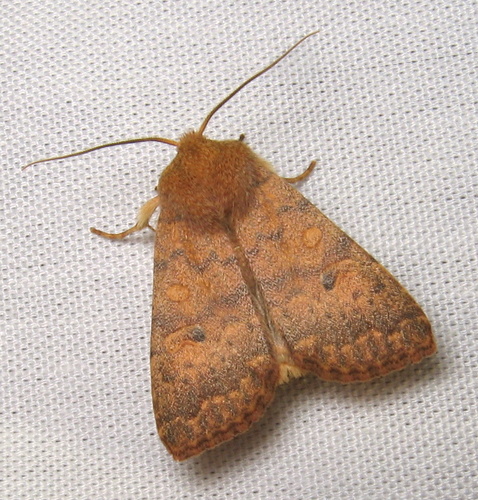
Bicolored Sallow
Sunira bicolorago
A late-autumn gem of the insect world, the Bicolored Sallow braves the cooling nights of fall. With its striking two-tone wings, this moth is a master of camouflage and a common visitor to backyard sugar stations.
Quick Identification
Size
Wingspan of 2.8 to 3.8 cm (1.1 to 1.5 inches); body length approximately 1.5 to 2 cm (0.6 to 0.8 inches)
Colors
Forewings are distinctly bicolored with a pale yellow or orange-buff inner half and a darker purplish-brown or gray outer half; hindwings are dark smoky gray.
Key Features
- Distinct division between light inner wing and dark outer wing
- Small, dark-outlined kidney-shaped spot (reniform) on the forewing
- Overall tawny or golden-orange hue
- Active primarily in late autumn
When You’ll See Them
Geographic range
Where Does the Bicolored Sallow Live?
The Bicolored Sallow is native to North America, where it maintains a widespread presence throughout the eastern and central portions of the continent. Its territory stretches from the southern provinces of Canada, including Ontario and Quebec, down through the United States to the Gulf Coast and as far west as the Great Plains. It is particularly abundant in the temperate deciduous forests of the Northeast and Midwest, making it one of the most common late-season moths encountered by backyard observers in these regions.
Basemap © OpenStreetMap contributors
Behavior
The Bicolored Sallow is a fascinating nocturnal moth known for its resilience to cold temperatures. While most moth species vanish as the first frosts arrive, this hardy insect is most active during the late autumn months, often flying well into November. During the day, they remain perfectly camouflaged against dried leaves or tree bark, relying on their earthy tones to avoid predators.
Unlike many moths that are strictly nectar-feeders, the Bicolored Sallow is frequently seen feeding on fermenting tree sap and overripe, rotting fruit. This behavior makes them social in a sense, as multiple individuals may gather around a single 'sugar source' on a cool October evening. They are also attracted to artificial lights, though they are more likely to be found on a baited tree trunk than circling a porch light.
EverydayEarth exclusive
Camera Tips
Capturing the Bicolored Sallow on camera requires a different approach than daytime wildlife. Since these moths are late-season specialists, your best window for success is from September through November. To attract them, use a technique called 'moth sugaring.' Create a bait by mixing overripe bananas, brown sugar, and a splash of beer or molasses. Paint this mixture in a square patch on the trunk of a mature hardwood tree at eye level.
Position your AI-powered camera or trail cam on a tripod approximately 3 to 5 feet away from the bait patch. Ensure the camera is set to 'Macro' or a close-focus mode if available, as these moths are small. Because they are active at night, use a camera with high-quality infrared (IR) capabilities to avoid startling them with a bright white flash, though a gentle, warm external light can sometimes produce better color photos of their distinctive orange and purple wings.
Set your camera to trigger on movement, but be aware that wind-blown leaves can cause false triggers. Using a 'time-lapse' mode that takes a photo every 5-10 minutes can also be an effective way to monitor the bait station throughout the night. For the best results, choose a calm, overcast night when temperatures are above 45°F (7°C), as these are the peak activity conditions for the Bicolored Sallow.
Similar Species
Species that look similar or are commonly confused with Bicolored Sallow.
Frequently Asked Questions
Record Bicolored Sallow at your habitat
Connect a camera to start building your own species record — AI identifies every visitor automatically.