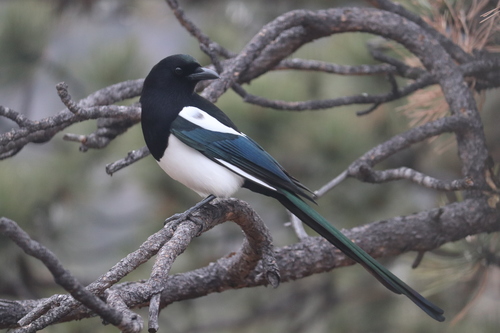
Black-billed Magpie
Pica hudsonia
With its tuxedo-like plumage and a tail that shimmers like oil on water, the Black-billed Magpie is the undisputed genius of the American West. These social, chatty birds bring a burst of personality and cleverness to any backyard camera setup.
Quick Identification
Size
Length: 45–60 cm (18–24 in); Wingspan: 56–61 cm (22–24 in); Weight: 145–210 g (5.1–7.4 oz)
Colors
Stark black and white plumage; wings and tail exhibit brilliant iridescent shades of blue, teal, and violet; underparts and shoulder patches are pure white.
Key Features
- Extraordinarily long, iridescent wedge-shaped tail
- Large white patches on the primary wing feathers visible in flight
- Stark white belly and shoulder patches against a black body
- Thick, powerful black bill and expressive dark eyes
When You’ll See Them
Sightings on EverydayEarth
Jun 9, 2026
An Osprey sits alertly in a large stick nest, looking out over a wide, green valley. In the background, a Black-billed Magpie flies across the distant field, moving from left to right.
Jun 7, 2026
An Osprey lands in the nest, adjusting its wings as it settles down. In the background, a Black-billed Magpie flies in and perches on a wooden post, observing the area.
Jun 3, 2026
An Osprey is settled comfortably in its stick nest in the foreground, occasionally adjusting its position and looking around. In the background, a second Osprey is perched on a wooden post, holding a fish in its talons. A Black-billed Magpie is seen flying across the green field in the distance on the left side of the frame.
Apr 28, 2026
An Osprey stands sentinel on a wooden post overlooking its nest, occasionally turning its head to scan the surrounding marshland. Meanwhile, a Black-billed Magpie hops around the base of the nest platform, likely searching for scraps or nesting material.
Apr 26, 2026
An Osprey perches on a wooden post overlooking its large stick nest, opening its beak to call out across the valley. In the background, a Black-billed Magpie is seen hopping along the ground near a dirt path.
Apr 1, 2026
A Black-billed Magpie is perched on a wooden post, looking out over the open field and valley. After a few moments of scanning its surroundings, it takes flight, moving towards the right side of the frame.
Geographic range
Where Does the Black-billed Magpie Live?
Native to the vast landscapes of North America, the Black-billed Magpie is a quintessential bird of the western half of the continent. Its core range stretches from south-central Alaska and western Canada through the Great Plains and the Rocky Mountain states, reaching as far south as northern New Mexico and Arizona. These birds are primarily year-round residents, thriving in a variety of environments from rural cattle ranches to bustling suburban neighborhoods throughout the western United States.
Basemap © OpenStreetMap contributors
Behavior
Black-billed Magpies are among the most intelligent animals in the world, belonging to the brainy corvid family alongside crows and jays. They are highly social birds that often travel in loose flocks and are known for their complex vocalizations, ranging from harsh 'mag-mag-mag' calls to soft, musical warbles. In suburban settings, they are remarkably bold and curious, often investigating new objects or 'scolding' predators like hawks or domestic cats from the safety of a tree branch.
These birds are famous for their engineering skills, specifically their massive, domed nests which can take up to 40 days to build. These 'bird mansions' consist of a sturdy stick framework with two entrances and a mud-lined interior. Magpies are also known for their symbiotic relationships with large mammals; it is common to see them perched on the backs of deer or elk, picking off ticks and other parasites, a behavior that showcases their opportunistic nature.
EverydayEarth exclusive
Camera Tips
To capture high-quality footage of Black-billed Magpies, position your camera approximately 2 to 3 feet off the ground. Since these birds spend a significant amount of time foraging on the floor, a low-angle setup near a known feeding spot or a birdbath will yield the most intimate shots. If you have a fence, mounting the camera on a post looking down the length of the rail is an excellent strategy, as magpies love to use fence lines as 'runways' before dropping into a yard.
Magpies are highly attracted to high-protein rewards. To lure them into your camera's field of view, use suet cakes, unsalted peanuts, or even small amounts of wet cat food placed in a heavy ceramic dish to prevent them from dragging the 'bait' out of frame. During the winter months, they are much more likely to visit residential stations in search of easy calories. Because they are clever and wary, try to conceal your camera using natural brush or a camo wrap, as they may spend several minutes inspecting a new device before approaching it.
For the best visual results, aim for a location with soft morning light. Magpies have high-contrast black and white feathers that can easily 'blow out' in harsh midday sun, making it hard to see detail in the whites. Set your camera to take short video clips (10-15 seconds) rather than just stills, as their social interactions and head-tilting curiosity are much more captivating in motion. A fast trigger speed is essential, as they are quick to take flight at the slightest movement.
Similar Species
Species that look similar or are commonly confused with Black-billed Magpie.
Yellow-billed Magpie
Virtually identical in plumage but features a bright yellow bill and is found only in California's Central Valley.
American Crow
Lacks the white belly and shoulder patches and has a much shorter, fan-shaped tail compared to the magpie's long, tapered tail.
California Scrub-Jay
Smaller with a blue back and head, lacking the stark black-and-white contrast and the extremely long tail of the magpie.
Frequently Asked Questions
Record Black-billed Magpie at your habitat
Connect a camera to start building your own species record — AI identifies every visitor automatically.