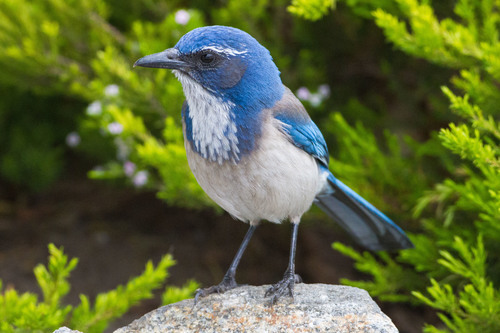
California Scrub-Jay
Aphelocoma californica
Meet the California Scrub-Jay, the intelligent and bold acrobat of the West. Known for its striking blue plumage and incredible memory, this charismatic corvid is a master of the backyard landscape.
Quick Identification
Size
Length: 27-31 cm (11-12 in); Wingspan: 39 cm (15 in); Weight: 70-100 g (2.5-3.5 oz)
Colors
Deep azure blue on the head, wings, and tail; brownish-gray back; white throat with a distinct blue 'necklace'; pale gray underparts. No crest.
Key Features
- No crest on head (unlike Blue Jays)
- Bold white eyebrow stripe
- Deep blue necklace framing a white throat
- Slender, slightly hooked black beak
When You’ll See Them
Sightings on EverydayEarth
Jul 13, 2026
A California Scrub-Jay is seen foraging on the ground in the lower-left area of the frame. It hops through the dry grass, scanning for food, and is visible for the first several seconds of the clip. A large, weathered animal carcass lies in the center of the clearing, though no wildlife is seen interacting with it. The video feed begins to suffer from heavy digital noise and signal loss halfway through the sequence.
Apr 5, 2026
A California Scrub-Jay is foraging inside the hollow of a large tree, which appears to be a nesting site. The bird hops across the floor of the cavity, pecking through twigs and nesting debris.
Geographic range
Where Does the California Scrub-Jay Live?
The California Scrub-Jay is native to the western coastal regions of North America. Its core range extends from southern British Columbia southward through the Pacific states of Washington and Oregon, blanketing nearly all of California and spilling into western Nevada. These birds are permanent residents across their range, thriving in the Mediterranean climates and oak-heavy landscapes of the West Coast.
Basemap © OpenStreetMap contributors
Behavior
California Scrub-Jays are highly intelligent and assertive members of the Corvid family. Unlike many birds, they are non-migratory and form long-term pair bonds, defending their territory year-round. They are particularly famous for their episodic memory; they can cache thousands of nuts and seeds throughout the autumn and remember the exact location of each one months later. They have even been observed re-hiding their food if they notice another bird watching them, a sign of advanced social cognition.
These birds are quite bold around humans and often become 'tame' enough to visit porch railings or even take peanuts from a hand. Their social structure is complex, and they use a variety of harsh, rasping calls to communicate. In your backyard, you will likely see them hopping energetically on the ground or darting between oak trees, often carrying an acorn or a large insect in their beak.
EverydayEarth exclusive
Camera Tips
To capture the best footage of a California Scrub-Jay, place your camera near a flat, elevated perch like a fence rail, a deck railing, or a wide platform feeder. These jays are incredibly observant and will often 'scout' a location from a higher branch before landing. Setting your camera at eye level (about 4-5 feet off the ground) and aiming it at a consistent landing spot will yield the most striking portraits of their azure plumage.
The secret to attracting these birds to your lens is whole, unsalted peanuts in the shell. Scrub-jays find these irresistible and will frequently return to the same spot every few minutes to collect a peanut and fly off to cache it. If you place a small pile of peanuts in a well-lit area, you can capture their fascinating 'weighing' behavior, where they pick up several nuts to find the heaviest one before departing. Use a high-speed trigger setting or video mode, as they move with quick, jerky motions that can blur on slower cameras.
Lighting is crucial for capturing the true vibrancy of their blue feathers. Early morning or late afternoon light—the 'golden hour'—really makes their blue tones pop without blowing out the white of their throat. Because they are year-round residents, you can get great shots in any season; however, in the fall, you may capture unique footage of them gathering and burying acorns. If using a trail camera, ensure the PIR sensitivity is set to 'High' to catch them during their fast, swooping landings.
Similar Species
Species that look similar or are commonly confused with California Scrub-Jay.
Woodhouse's Scrub-Jay
Found further inland in the Rockies; has a duller blue color and a less distinct white eyebrow and necklace.
Steller's Jay
Features a prominent black crest and much darker, sootier blue and black plumage.
Blue Jay
Native to Central/Eastern North America; has a distinct head crest and white wing bars.
Frequently Asked Questions
Record California Scrub-Jay at your habitat
Connect a camera to start building your own species record — AI identifies every visitor automatically.