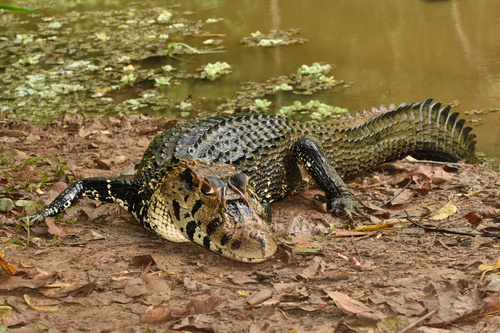
Black Caiman
Melanosuchus niger
The black caiman is the undisputed king of the Amazonian waters, a prehistoric giant that can grow up to 20 feet long. With its sleek jet-black armor and massive jaws, it remains one of the most formidable apex predators in South America.
Quick Identification
Size
Length 4–6 meters (13–20 ft); weight up to 500 kg (1,100 lbs) or more.
Colors
Jet black to dark olive-black skin; grey-brown bands on the lower jaw; pale yellow or white banding on the flanks (more prominent in juveniles).
Key Features
- Jet-black scales providing camouflage in dark waters
- Heavy, broad skull with a prominent bony ridge between the eyes
- Prominent white or yellow banding on the sides
- Eyes and nostrils positioned on top of the head for submerged breathing
When You’ll See Them
Geographic range
Where Does the Black Caiman Live?
The black caiman is native to the South American continent, where it reigns over the vast Amazon River Basin. Its core range spans the tropical heart of the continent, including Brazil, Peru, Colombia, Bolivia, and Ecuador. These massive reptiles are also found in the wetlands of Guyana and French Guiana, strictly adhering to freshwater systems and avoided high-flow mountain streams. This species is a lowland specialist, thriving in the deep, still waters of the interior rainforest.
Basemap © OpenStreetMap contributors
Behavior
The black caiman is the undisputed apex predator of the Amazon Basin. As a primarily nocturnal hunter, it spends its days basking on riverbanks to regulate its body temperature, often appearing sluggish and sedentary in the sun. However, once the sun sets, this reptile becomes a highly efficient and aggressive hunter, utilizing its dark coloration to blend into the shadows of the water's surface.
While they are solitary for much of the year, black caimans can congregate in large numbers during the dry season when water levels recede into smaller pools. They are known for their territorial nature, especially during the nesting season when females become fiercely protective of their mound-like nests. Despite their fearsome reputation, they generally avoid human contact unless provoked or if their territory is encroached upon, though their massive size makes them potentially dangerous neighbors in remote riverside communities.
EverydayEarth exclusive
Camera Tips
To capture a black caiman on camera, focus your efforts on the water-to-land transition zones. Look for 'slides'—areas of flattened mud or vegetation where the caiman regularly hauls itself out of the water to bask. Position your camera about 2 to 3 feet off the ground, angled slightly downward toward the mudbank. Because these are massive animals, ensure the camera is far enough back to capture the entire body rather than just a patch of dark scales.
Since the black caiman is most active after dark, your camera's infrared (IR) performance is critical. They have highly reflective 'eye-shine,' which can create stunning night captures but can also blow out the image if the flash is too direct. If your camera allows it, use a 'medium' IR flash setting to capture the texture of their dark skin without overexposing the eyes. High-resolution video mode is preferred over stills to capture their slow, prehistoric movements.
Safety is paramount when setting cameras in caiman territory. Never place a camera while standing in the water or at the immediate water's edge in low-light conditions. During the dry season (typically July to December), these reptiles are more concentrated around remaining water holes, making this the best time for high-traffic captures. You don't need bait; their natural travel paths between deep water and basking spots are usually consistent and predictable.
Similar Species
Species that look similar or are commonly confused with Black Caiman.
Frequently Asked Questions
Record Black Caiman at your habitat
Connect a camera to start building your own species record — AI identifies every visitor automatically.