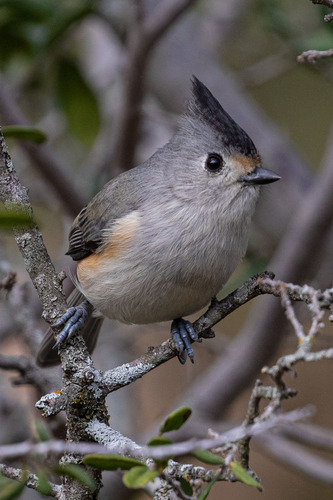
Black-crested Titmouse
Baeolophus atricristatus
With its striking jet-black crest and inquisitive personality, the Black-crested Titmouse is a charismatic star of the Texas Hill Country. These bold little birds are constant companions for backyard birders, bringing endless energy to every feeder they visit.
Quick Identification
Size
Length: 14-15 cm (5.5-6 in); Wingspan: 22-25 cm (8.7-9.8 in); Weight: 16-20 g (0.56-0.71 oz)
Colors
Soft gray upperparts and white underparts with rusty/buffy flanks. Distinctive black crest and a white to pale gray forehead.
Key Features
- Prominent jet-black pointed crest
- White or pale forehead patch
- Large, dark eyes on a pale face
- Small, stout black bill designed for cracking seeds
When You’ll See Them
Geographic range
Where Does the Black-crested Titmouse Live?
The Black-crested Titmouse is a signature species of the American Southwest and Northeastern Mexico. Native to the North American continent, its core range is concentrated in Central and Southern Texas, extending northward into southwestern Oklahoma. South of the border, it is a widespread resident throughout the Mexican states of Coahuila, Nuevo León, and Tamaulipas, thriving in both arid scrub and lush riparian habitats.
Basemap © OpenStreetMap contributors
Behavior
The Black-crested Titmouse is an exceptionally energetic and social bird, often seen flitting through the canopy in search of food. They are known for their 'clutch-and-go' feeding style, where they quickly grab a seed from a feeder and retreat to a nearby branch to hammer it open. During the non-breeding season, they frequently join mixed-species foraging flocks, traveling alongside chickadees, kinglets, and woodpeckers.
These birds are remarkably bold and inquisitive, often being the first to investigate a new object or sound in their environment. They are highly vocal, possessing a wide repertoire of whistled songs and rasping 'chick-a-dee' calls. In backyards, they are frequent visitors to feeders and are known to be quite dominant over smaller birds despite their own diminutive size.
EverydayEarth exclusive
Camera Tips
To capture high-quality footage of the Black-crested Titmouse, place your camera approximately 5 to 6 feet off the ground, facing a platform feeder or a suet cage. These birds are incredibly fast, so a camera with a high frame rate or a rapid-fire trigger mode is essential to catch them mid-hop. Position the camera about 3 to 4 feet from the feeder to ensure the details of the black crest and white forehead are crisp and in focus.
The best bait for attracting this species is black oil sunflower seeds or shelled peanuts. Because they often grab a seed and immediately fly to a nearby perch to hammer it open, try placing a natural-looking 'staging branch' a few feet away from your feeder and aim a second camera there. This is where you will get the best behavioral shots of them using their feet to hold a seed while striking it with their bill.
Don't overlook the importance of water. These birds are frequent visitors to birdbaths, especially in the dry heat of Texas and Mexico. A shallow stone basin with a small solar dripper or bubbler is a magnet for them. In the spring, you can attract them for close-ups by providing nesting materials like pet hair or wool in a suet cage, which they will eagerly harvest to line their tree-cavity nests.
Similar Species
Species that look similar or are commonly confused with Black-crested Titmouse.
Frequently Asked Questions
Record Black-crested Titmouse at your habitat
Connect a camera to start building your own species record — AI identifies every visitor automatically.