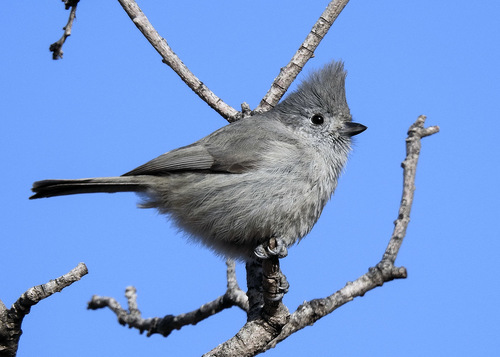
Juniper Titmouse
Baeolophus ridgwayi
The spunky spirit of the high desert, the Juniper Titmouse is a master of survival in the arid West. With its signature crest and lively personality, it's a year-round delight for backyard birdwatchers and camera enthusiasts alike.
Quick Identification
Size
Length: 5.1-5.9 in (13-15 cm); Wingspan: 9 in (23 cm); Weight: 0.5-0.8 oz (15-22 g)
Colors
Uniformly brownish-gray upperparts and paler gray underparts; dark eyes; black bill; male and female are identical in appearance.
Key Features
- Small pointed gray crest
- Uniform gray-brown plumage without strong markings
- Short, stout black bill
- Acrobatic foraging behavior
When You’ll See Them
Geographic range
Where Does the Juniper Titmouse Live?
The Juniper Titmouse is a specialist of the interior Western United States, predominantly found across the Great Basin and the Four Corners region. Its native range spans from southeastern Oregon and southern Idaho through Nevada, Utah, and western Colorado, extending south into Arizona and New Mexico. Unlike migratory songbirds, this species remains in these high-desert woodland habitats year-round, making it a permanent fixture of the Western landscape.
Basemap © OpenStreetMap contributors
Behavior
The Juniper Titmouse is a charismatic and energetic resident of the arid West. Unlike many other backyard birds, they are strictly monogamous and maintain their territories throughout the year. They are highly vocal birds, often the first to sound an alarm if a predator like a hawk or cat is nearby, using a series of raspy, scolding notes. While they are curious and may investigate human activity, they tend to be slightly more reserved than their Eastern cousins, the Tufted Titmice.
Foraging is a constant activity for these birds. They are exceptionally agile, often hanging upside down from juniper branches or pinyon pine cones to reach seeds and insects. When they find a large seed or nut, they typically fly to a nearby branch, pin the food between their feet, and hammer it open with their stout bills. During the winter, they occasionally join mixed foraging flocks with nuthatches and kinglets, though they remain fiercely protective of their home range.
EverydayEarth exclusive
Camera Tips
To capture the best footage of a Juniper Titmouse, focus your camera on a platform feeder or a suet cage. They are specifically attracted to black oil sunflower seeds and high-fat suet blends. Because these birds are "snatch-and-grab" feeders—meaning they rarely sit and eat on the perch—you should set your camera's trigger speed to its fastest setting and use a burst mode (3-5 photos per trigger) to ensure you catch them before they fly off to a nearby branch.
Water is a powerful lure in the arid environments where these birds live. A birdbath with a small dripper or solar fountain will be an irresistible draw. Place your camera about 3 to 4 feet away from the water source, ideally at a 45-degree angle to the sun to highlight the subtle textures of their gray feathers. If using a trail camera, ensure it has a close-focus feature, as these birds are small and look best when they fill more of the frame.
During the spring nesting season (April through June), you can place cameras near natural tree cavities or nest boxes. Juniper Titmice are cavity nesters and will readily use boxes with a 1.25-inch entrance hole. Position the camera to face the entrance from a distance of 5-8 feet to avoid disturbing the parents. This provides a fantastic opportunity to see them carrying caterpillars and other insects back to the nest, showcasing their role as natural pest controllers in your backyard.
Similar Species
Species that look similar or are commonly confused with Juniper Titmouse.
Oak Titmouse
Nearly identical visually but separated by geography; the Oak Titmouse is restricted to California and parts of Oregon, preferring oak woodlands over juniper.
Bridled Titmouse
Found in the Southwest, this cousin has a distinct black-and-white 'bridled' pattern on its face.
Black-capped Chickadee
Lacks the crest of the titmouse and features a distinct black cap and bib with white cheeks.
Frequently Asked Questions
Record Juniper Titmouse at your habitat
Connect a camera to start building your own species record — AI identifies every visitor automatically.