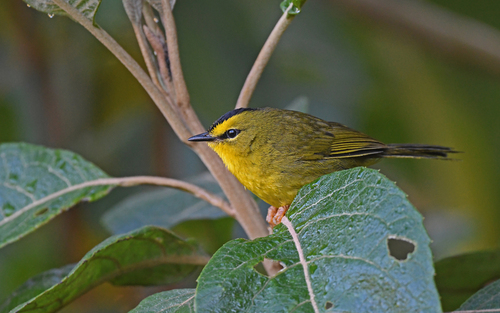
Black-crested Warbler
Myiothlypis nigrocristata
With its brilliant yellow plumage and a striking black crown, the Black-crested Warbler is a vibrant jewel of the high Andes. This restless insect-hunter is a favorite for backyard birders in South America's montane regions.
Quick Identification
Size
Length: 13-14 cm (5.1-5.5 in); Weight: 11-15 g (0.4-0.5 oz)
Colors
Bright yellow face and underparts, olive-green back and wings, and a distinctive jet-black crown/crest. Males and females are virtually identical.
Key Features
- Prominent black crown stripe
- Vibrant yellow eyebrow and underparts
- Olive-green upperparts
- Small, pointed bill for insect gleaning
When You’ll See Them
Geographic range
Where Does the Black-crested Warbler Live?
Native to the South American continent, the Black-crested Warbler is a quintessential bird of the Andes Mountains. Its range forms a continuous ribbon along the mountain chain, stretching from the coastal cordillera of Venezuela through the eastern and central Andes of Colombia and Ecuador, reaching as far south as central Peru. This species is a high-altitude specialist, thriving in the cool, misty environments of the cloud forests and the high-elevation scrublands known as páramo edges.
Basemap © OpenStreetMap contributors
Behavior
The Black-crested Warbler is a remarkably active and restless bird, rarely staying still for more than a few seconds as it flits through the dense undergrowth and middle layers of the forest. Unlike many shy forest birds, this species is often quite bold and may approach humans out of curiosity, especially if you are near a forest edge or a garden clearing. They are typically found in pairs or small family groups, maintaining contact with high-pitched, thin calling notes as they move through the foliage.
These birds are frequent participants in mixed-species foraging flocks, often seen alongside tanagers and other Andean warblers. While they spend much of their time in thick vegetation, they are known to venture into the open at the edges of trails or gardens. Their social structure is largely centered around a stable pair bond, and they are highly territorial during the breeding season, using their sharp songs to defend their patch of the montane forest.
EverydayEarth exclusive
Camera Tips
To capture the Black-crested Warbler on an AI-powered camera, placement is everything. These birds are low-to-mid-story dwellers, meaning they rarely visit the high canopy or stay directly on the flat ground for long. Aim your camera at knee-to-waist height (about 0.5 to 1.5 meters), focusing on dense shrubbery, bamboo stands, or the interface where a garden meets a wooded area. An angle that looks slightly upward into a favorite perching branch can provide stunning shots of their namesake black crest.
Because they are extremely fast-moving, use a camera with a high trigger speed and a short recovery time. If your camera supports 'Burst Mode' or high-frame-rate video, enable it to ensure you catch the bird mid-hop rather than just a blur of yellow feathers. Since they are naturally curious, they are often drawn to the sound of moving water; a small solar-powered fountain or a dripping birdbath in an Andean garden is the single best 'lure' for this species.
Lighting can be tricky in their native cloud forest habitat, which is often misty or dim. If possible, position the camera so it faces away from the morning sun to avoid silhouetting. While they are active throughout the day, the first two hours of daylight offer the most intense foraging activity. Unlike some larger birds, they aren't usually attracted to traditional seed feeders, but maintaining a garden with native flowering shrubs that attract insects will keep them within your camera's field of view consistently.
Similar Species
Species that look similar or are commonly confused with Black-crested Warbler.
Frequently Asked Questions
Record Black-crested Warbler at your habitat
Connect a camera to start building your own species record — AI identifies every visitor automatically.