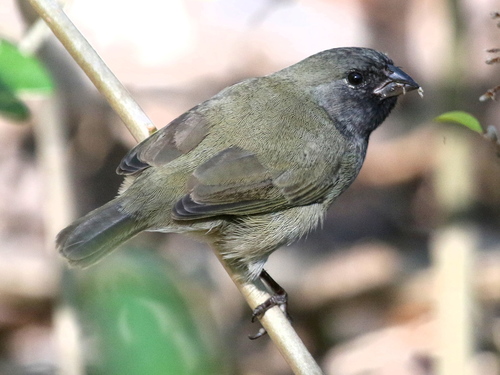
Black-faced Grassquit
Melanospiza bicolor
A spirited and social tanager of the West Indies, the Black-faced Grassquit is a master of the garden floor. Known for its buzzy song and distinctive dark mask, it is a delightful addition to any tropical backyard camera setup.
Quick Identification
Size
Length: 10-11 cm (4-4.3 in); Weight: 8-12 g (0.28-0.42 oz)
Colors
Males feature a soot-black face, throat, and breast contrasting with olive-green upperparts; females are dull olive-brown above and pale grayish-buff below.
Key Features
- Stubby conical black bill
- Male has distinctive black 'mask' and chest
- Short, slightly notched tail
- Hopping ground-foraging movement
- Dull olive-green wings and back
When You’ll See Them
Geographic range
Where Does the Black-faced Grassquit Live?
The Black-faced Grassquit is a quintessential bird of the Caribbean and the northern fringes of South America. It is found natively throughout the West Indies—including the Bahamas, Jamaica, and Puerto Rico—though it is notably absent from Cuba. Its range extends south into the coastal regions of Colombia and Venezuela, where it thrives in both natural grasslands and human-altered landscapes.
Basemap © OpenStreetMap contributors
Behavior
The Black-faced Grassquit is a social and energetic bird, frequently seen in pairs or small family groups. They are ground-dwellers by nature, spending much of their day hopping through short grass or along the edges of pathways in search of fallen seeds. While they can be wary of sudden movements, they are remarkably well-adapted to human environments and often become 'backyard regulars' in suburban areas across the Caribbean.
Their flight is typically short and jerky, moving from the ground to a low bush for cover. During the breeding season, males become more conspicuous, often perching on a tall grass stalk or fence wire to deliver their buzzy, mechanical song. They are not highly territorial outside of nesting, and you will often see them foraging alongside other small finches and seed-eaters.
EverydayEarth exclusive
Camera Tips
To successfully capture the Black-faced Grassquit on camera, placement is everything. These birds are low-level foragers, so position your camera just 6 to 12 inches off the ground. Aim the lens at a flat patch of dirt or short grass near a 'staging area' like a low hedge or brush pile. They prefer to hop out from cover, grab a seed, and hop back, so setting your camera near the edge of a thicket will yield the best results.
Because they are small and blend into green foliage, use a high-sensitivity trigger setting. If your camera has a 'pre-roll' or high-speed video mode, enable it; grassquits are fast and can be in and out of the frame in seconds. Using a focal distance suited for close-up shots (macro or near-field) will help highlight the fine textures of the male's black plumage and the female's subtle olive tones.
To lure them into view, scatter white proso millet or a fine-textured wild bird seed mix directly on the ground. They are much more comfortable feeding on the earth than on elevated hanging feeders. A shallow ground-level birdbath is also a magnet for this species, especially during the dry season. For the best lighting, face your camera North or South to avoid the harsh tropical glare of the rising or setting sun, which can wash out the dark details of the male's face.
Similar Species
Species that look similar or are commonly confused with Black-faced Grassquit.
Yellow-faced Grassquit
The Yellow-faced Grassquit has bright yellow patches above the eyes and on the throat, which the Black-faced lacks.
Blue-black Grassquit
Males are a uniform glossy blue-black all over, lacking the olive-green back and wings of the Black-faced Grassquit.
Bananaquit
While similar in size, the Bananaquit has a bright yellow belly, a white eyebrow stripe, and a curved beak.
Frequently Asked Questions
Record Black-faced Grassquit at your habitat
Connect a camera to start building your own species record — AI identifies every visitor automatically.