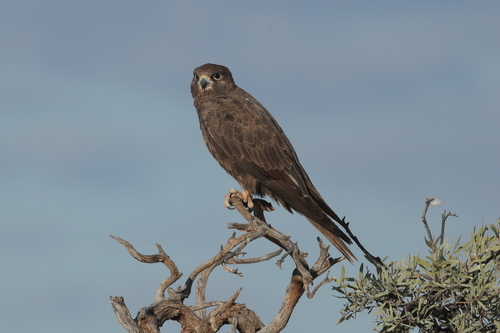
Black Falcon
Falco subniger
Australia's most mysterious raptor, the Black Falcon is a master of high-speed pursuit and nomadic survival. Known for its striking, soot-colored plumage and powerful flight, this elusive hunter is the dark shadow of the outback skies.
Quick Identification
Size
Length: 45–56 cm (18–22 in); Wingspan: 95–115 cm (37–45 in); Weight: 500–1,000 g (1.1–2.2 lbs)
Colors
Uniformly sooty black to dark chocolate brown; juveniles are darker; pale blue-grey bill and feet.
Key Features
- Uniformly dark plumage with a slightly paler throat
- Long, pointed wings that reach the tail tip when perched
- Heavy-chested, powerful silhouette in flight
- Pale blue-grey cere and eye-ring
When You’ll See Them
Geographic range
Where Does the Black Falcon Live?
The Black Falcon is an iconic nomad of the Australian continent, found across all mainland states and territories. This species is a specialist of the vast interior, thriving in the arid and semi-arid zones that define the heart of Australia, though it frequently wanders into the Mediterranean climates of the south and the tropical grasslands of the north. While it is rarely seen in Tasmania or the heavily forested coastal ranges, it is a common sight in the expansive wheat belts and pastoral lands where open skies provide the perfect hunting ground.
Basemap © OpenStreetMap contributors
Behavior
The Black Falcon is a bold and powerful aerial predator, known for a flight style that appears deceptively 'lazy' until it enters a high-speed pursuit. Unlike many other falcons that rely on steep dives (stoops), the Black Falcon often hunts by contour-hunting—flying low and fast over the ground to surprise prey, or by engaging in direct, exhausting tail-chases. They are highly intelligent opportunists, frequently observed following grass fires, farm machinery, or even other hunters to snatch up escaping birds and insects.
Socially, they are usually seen alone or in pairs, but they are remarkably nomadic. They lack the strict territoriality of the Peregrine Falcon, instead traveling vast distances across the Australian interior in response to rainfall and surges in prey populations. While generally wary of humans, they have adapted to agricultural landscapes where livestock and grain attract high numbers of their favorite avian prey.
EverydayEarth exclusive
Camera Tips
To capture the elusive Black Falcon on a backyard or trail camera, focus on verticality and water. These raptors prefer high, commanding perches to survey their surroundings. If you have a large property with a tall, dead tree (often called a 'stag'), mount your camera facing a prominent branch at the top. Use a telephoto lens or a high-resolution sensor, as these birds are unlikely to land directly in front of a low-mounted camera unless lured by a specific resource.
In drier regions, water is the ultimate magnet. A wide, shallow stone birdbath or a livestock trough can attract Black Falcons looking to drink or bathe during the heat of the day. Position your camera at the edge of the water source, angled slightly upward to catch the bird as it descends. Because falcons are incredibly fast, set your camera to the shortest possible trigger speed (ideally under 0.2 seconds) and use 'Burst Mode' to capture 3–5 rapid-fire photos. This increases your chances of getting a sharp image of their distinctive wing shape during takeoff.
Time of day is critical for lighting these dark-feathered birds. Because their plumage is sooty and uniform, they can easily appear as a featureless silhouette in harsh midday sun. Aim for the 'golden hours' of early morning or late afternoon when the low sun angle can highlight the subtle textures and brown tones in their feathers. If your camera allows for exposure adjustment, consider overexposing by +0.5 or +1.0 to ensure the dark underside of the bird isn't lost in shadow against a bright sky.
Similar Species
Species that look similar or are commonly confused with Black Falcon.
Frequently Asked Questions
Record Black Falcon at your habitat
Connect a camera to start building your own species record — AI identifies every visitor automatically.