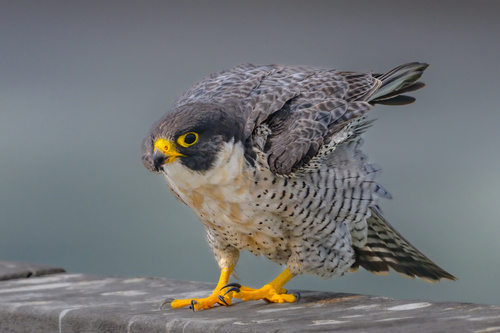
Peregrine Falcon
Falco peregrinus
Meet the world's fastest animal. With diving speeds exceeding 200 mph, the Peregrine Falcon is a master of the air that has traded the wilderness for the urban jungle.
Quick Identification
Size
Length: 34-58 cm (13-23 in); Wingspan: 74-120 cm (29-47 in); Weight: 0.7-1.5 kg (1.5-3.3 lbs)
Colors
Slate-blue or blue-grey upperparts with dark barring; creamy white underparts with fine horizontal bars; dark head with a prominent black 'mustache' or malar stripe.
Key Features
- Distinctive dark 'hood' and sideburns
- Long, pointed wings built for speed
- Heavily barred white or buff underparts
- Yellow eye-ring and cere (base of the beak)
When You’ll See Them
Sightings on EverydayEarth
Mar 31, 2026
Four Peregrine Falcon eyasses, covered in white down, are huddled together in a rocky cliffside nest. The chicks are active, turning their heads and shifting positions. At the very end of the sequence, an adult falcon quickly enters the frame from the bottom left.
Aug 1, 2026
A Peregrine Falcon is perched on a rocky ledge under a stone overhang. It remains mostly still, looking around its surroundings and briefly ruffling its feathers.
Aug 1, 2026
A Peregrine Falcon is perched on a high rocky ledge under a cliff overhang. The bird is alert, turning its head to scan the surroundings and blinking, showing off its distinctive dark hood and barred plumage.
Aug 1, 2026
A Peregrine Falcon is perched on a narrow rocky ledge overlooking a lush green valley. It remains stationary, looking out over the landscape and occasionally shifting its weight.
Jul 31, 2026
An adult Peregrine Falcon is perched prominently on a lower cliff ledge, looking around and occasionally preening its feathers. In the background, a second falcon is visible resting on a higher ledge under a rock overhang. Both birds appear calm while overlooking the expansive river valley below.
Jul 30, 2026
An adult Peregrine Falcon is seen inside a nest box tending to several white, downy chicks. The adult carefully tears off small pieces of food and feeds them to the chicks as they stretch their necks up with open mouths.
Behavior
The Peregrine Falcon is the undisputed king of the skies, legendary for its high-speed hunting dive known as a 'stoop,' which can reach speeds of over 200 mph. These birds are apex predators that primarily hunt other birds in mid-air. Unlike many raptors that prefer perching and waiting, Peregrines are active searchers, often patrolling high above the ground or scanning from the tallest available vantage points, such as skyscrapers, water towers, or cliff faces.
While they are naturally solitary and territorial, Peregrine Falcons have become surprisingly well-adapted to human environments. In urban and suburban settings, they use tall buildings as artificial cliffs and feast on the abundant pigeon and starling populations. They are generally wary of humans but can be observed relatively closely if they have established a regular 'plucking post'—a flat surface where they take their prey to consume it.
EverydayEarth exclusive
Camera Tips
Capturing a Peregrine Falcon on a backyard camera is the 'holy grail' for many enthusiasts because of their height and speed. To succeed, you must think vertically. If you live in an area with these falcons, avoid placing your camera on the ground. Instead, mount your AI-powered camera on a roofline, a high chimney, or a dedicated pole at least 10-15 feet high, overlooking an open flight path. They prefer wide-open views where they can spot both prey and potential threats from a distance.
One of the best ways to lure a Peregrine into camera range is to identify a 'plucking post.' Look for flat, elevated surfaces like the top of a pergola, a flat roof, or a sturdy high branch that has a scattering of feathers nearby. Peregrines often return to the same spot to strip and eat their catch. Setting your camera to a high-sensitivity motion trigger is essential, as their movements are lightning-fast. Use a fast shutter speed setting if your camera allows it to avoid motion blur during their rapid take-offs and landings.
While you shouldn't use food as bait (as they only eat fresh, self-caught prey), a large, elevated stone birdbath can occasionally attract them for a drink or a bath, especially in summer. Place the camera at a 45-degree downward angle to capture the intricate feather patterns on their back. Because they are most active during the first few hours of light, ensure your camera is positioned to avoid direct lens flare from the rising sun, which can wash out the fine detail of their plumage.
Similar Species
Species that look similar or are commonly confused with Peregrine Falcon.
Cooper's Hawk
Has rounded wings and a long, banded tail; lacks the Peregrine's dark facial 'mustache' stripes.
Merlin
Much smaller (pigeon-sized) with a less distinct facial pattern and faster, wing-heavy flight.
Prairie Falcon
Paler brown overall with distinctive dark 'armpits' (axillaries) visible only when in flight.
Frequently Asked Questions
Record Peregrine Falcon at your habitat
Connect a camera to start building your own species record — AI identifies every visitor automatically.