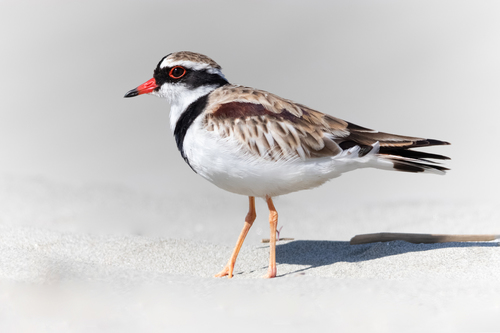
Black-fronted Dotterel
Thinornis melanops
With its striking black 'V' chest band and vibrant red eye-ring, the Black-fronted Dotterel is a miniature masterpiece of the southern wetlands. Often seen bobbing along muddy shorelines, this resilient little plover is a master of camouflage and a delight for backyard observers near water.
Quick Identification
Size
Length: 16–18 cm (6.3–7.1 in); Wingspan: 33–35 cm (13–13.8 in); Weight: 30–40 g (1.1–1.4 oz)
Colors
Sandy-brown back with dark mottling; white underparts with a bold black 'V' shaped breast band; white forehead and throat; red eye-ring and red bill with a black tip.
Key Features
- Bold black 'V' band across a white chest
- Bright red eye-ring and red-based bill
- Distinctive bobbing motion of the head and tail
- Dark chestnut or blackish patch on the shoulder/wing
When You’ll See Them
Geographic range
Where Does the Black-fronted Dotterel Live?
Native to the Australian continent, the Black-fronted Dotterel is found throughout almost the entire mainland and Tasmania, showing a remarkable ability to thrive in both lush coastal regions and the arid interior. In the 1950s, the species naturally self-introduced to New Zealand, where it is now a widespread and established resident across both the North and South Islands. They are highly nomadic, often appearing suddenly in remote desert areas following heavy rains that create temporary inland waterways.
Basemap © OpenStreetMap contributors
Behavior
The Black-fronted Dotterel is a busy, charismatic shorebird characterized by its quick, rhythmic bobbing of the head and tail while standing. Unlike many other plovers that favor coastal beaches, this species is a specialist of freshwater environments. They are often seen running in short, rapid bursts along the muddy edges of ponds, stopping suddenly to peck at the ground. They are generally seen singly, in pairs, or in small family groups, though they may form larger flocks during particularly dry spells when water sources become scarce.
When nesting, these birds are famous for their 'broken-wing' display, a clever tactical maneuver where an adult feigns injury to lure potential predators away from their well-camouflaged eggs or chicks on the ground. Despite their small size, they are quite bold and can become accustomed to human presence in suburban parks and golf courses, provided they are given a respectful amount of space. They are mostly diurnal, though they have been known to forage on moonlit nights.
EverydayEarth exclusive
Camera Tips
To capture high-quality footage of the Black-fronted Dotterel, camera placement is everything. These are strictly ground-dwelling birds that rarely venture far from the immediate waterline. Mount your camera as low as possible—ideally just 10–15 centimeters (4–6 inches) off the ground—and angle it parallel to a flat stretch of mud or gravel bank. Placing the camera at the edge of a farm dam or a backyard pond with a gently sloping shore is ideal. Avoid areas with tall reeds that might obstruct the sensor or the view.
Because these birds move with rapid, jerky motions, use a camera with a fast trigger speed (0.2 seconds or less) and a high frame rate for video. If your camera allows for 'burst mode,' set it to take 3–5 photos per trigger to ensure you catch a sharp image between their constant bobs and dashes. They are most active during the golden hours of dawn and dusk, so ensure your camera has good low-light sensitivity. Avoid using white-flash at night as it may startle them; a no-glow infrared flash is much more discreet.
While you cannot easily 'bait' a dotterel with traditional birdseed, you can attract them by maintaining a shallow, muddy 'beach' area in your backyard if you have a water feature. They are attracted to the insects that congregate in moist soil. During the summer months, they are more likely to visit permanent water sources as smaller puddles dry up. If you are setting up near a nest (which is just a shallow scrape in the ground), be extremely careful not to disturb the area, as the eggs are perfectly camouflaged and easily stepped on.
Similar Species
Species that look similar or are commonly confused with Black-fronted Dotterel.
Frequently Asked Questions
Record Black-fronted Dotterel at your habitat
Connect a camera to start building your own species record — AI identifies every visitor automatically.