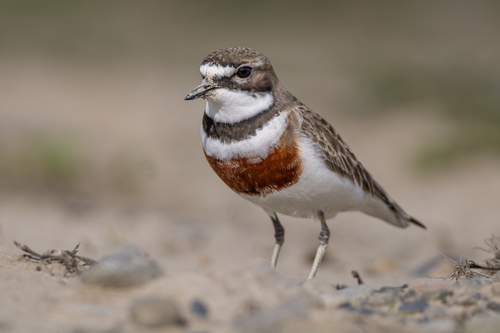
Double-banded Plover
Anarhynchus bicinctus
A striking shorebird of the South Pacific, the Double-banded Plover is famous for its twin chest bands and its incredible trans-Tasman migration.
Quick Identification
Size
18–21 cm (7–8.3 in) in length; wingspan of 40–45 cm (15.7–17.7 in); weighs 45–70 g (1.6–2.5 oz)
Colors
Grey-brown upperparts and white underparts. Breeding males show a thin black upper breast band and a wide chestnut lower band; females have similar but duller markings. Non-breeding adults lose the distinct bands.
Key Features
- Two distinct breast bands (upper black, lower chestnut) during breeding
- White forehead and prominent pale eyebrow stripe
- Short, dark bill and pale greenish-yellow to grey legs
- Stocky, rounded body with a large head
When You’ll See Them
Geographic range
Where Does the Double-banded Plover Live?
Native to the islands of the South Pacific, the Double-banded Plover is a true trans-Tasman traveler. While its primary breeding grounds are found across the diverse landscapes of New Zealand—including the Chatham and Auckland Islands—a significant portion of the population undergoes a remarkable migration to the eastern and southern coasts of Australia and Tasmania each autumn. This makes them a unique fixture of both New Zealand’s inland river systems and Australia’s coastal wetlands.
Basemap © OpenStreetMap contributors
Behavior
Double-banded Plovers are charismatic shorebirds known for their distinctive 'run-stop-peck' foraging method. They dart quickly across mudflats or sandy beaches, pause abruptly to scan for movement, and then dive to snatch up prey. While they are highly social during the non-breeding season, often forming large flocks in estuaries and coastal lagoons, they become fiercely territorial when nesting in braided riverbeds or coastal dunes.
One of their most fascinating behaviors is the 'broken-wing' distraction display. If a predator or a curious human gets too close to their well-camouflaged ground nest, the adult bird will flop along the ground, trailing a wing as if injured, to lure the threat away from its eggs or chicks. They are also remarkable navigators; a large portion of the population flies over 2,000 kilometers across the Tasman Sea to winter in Australia, a feat of endurance for such a small bird.
EverydayEarth exclusive
Camera Tips
To capture high-quality footage of the Double-banded Plover, camera placement is everything. Because these birds are ground-dwellers with a low profile, you must mount your camera just a few inches off the ground. A small tripod or a custom ground stake is ideal. Position the camera near the high-tide line on beaches or along the edges of muddy pools in estuaries, as these are their primary 'high-traffic' foraging lanes. Angle the camera slightly upward to capture the detail of their chest bands rather than just their backs.
Since these birds are easily spooked, use a camera with a fast trigger speed and a quiet shutter. Avoid placing cameras directly next to active nests, as this can attract predators or cause the parents to abandon the eggs; instead, focus on nearby feeding areas. In New Zealand riverbeds, look for open patches of shingle or gravel where the birds naturally congregate. Using a wide-angle lens can help capture the 'run-stop-peck' movement across the landscape, while a telephoto setup is better for identifying the subtle differences in band color between males and females.
Timing is also critical. These birds are most active during the daylight hours, particularly around the turn of the tide when new feeding grounds are exposed. If you are using a camera in a coastal area, check the local tide charts and set your capture intervals to be more frequent during the two hours before and after low tide. During the breeding season (August to December), you may capture their unique territorial displays, but be sure to keep a respectful distance and follow local conservation guidelines to protect this Near Threatened species.
Similar Species
Species that look similar or are commonly confused with Double-banded Plover.
Wrybill
The Wrybill has a single black breast band and a unique bill that always curves to the right.
Red-capped Plover
Smaller with a rufous crown and hindneck, and lacks the full double breast bands of the Double-banded Plover.
Black-fronted Dotterel
Features a prominent black 'V' on the chest and a bright red bill with a black tip.
Frequently Asked Questions
Record Double-banded Plover at your habitat
Connect a camera to start building your own species record — AI identifies every visitor automatically.