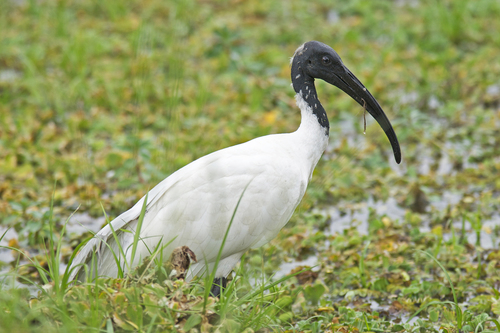
Black-headed Ibis
Threskiornis melanocephalus
With its striking monochrome appearance and elegant down-curved beak, the Black-headed Ibis is an iconic guardian of Asia's waterways. Whether wading through ancient rice paddies or soaring over tropical marshes, this social bird is a master of the wetland world.
Quick Identification
Size
Length: 65–76 cm (25.5–30 in); Wingspan: 110–130 cm (43–51 in); Weight: 1.2–1.8 kg (2.6–4 lbs)
Colors
Pure white body plumage with bare, jet-black skin on the head and neck; long black down-curved bill and black legs.
Key Features
- Distinctive bald black head and neck
- Long, scythe-shaped black bill
- Pure white plumage (grayish plumes appear in breeding season)
- Sturdy black legs and unfeathered under-wing patches
When You’ll See Them
Geographic range
Where Does the Black-headed Ibis Live?
The Black-headed Ibis is a signature species of the Asian tropics and subtropics, primarily native to the South Asian subcontinent and Southeast Asia. Its vast range spans from the river basins of India, Pakistan, and Sri Lanka across to the wetlands of Myanmar, Thailand, Vietnam, and Cambodia, reaching as far as the Indonesian archipelago. While they are mostly residents within this core range, some populations exhibit nomadic movements or partial migration driven by the arrival of the monsoon rains, with occasional sightings in East Asian countries like Japan and Taiwan.
Basemap © OpenStreetMap contributors
Behavior
The Black-headed Ibis is a highly social and gregarious wading bird, almost always found foraging in small to large flocks. They are tactile feeders, using their long, sensitive bills to probe deep into mud or soft soil to locate prey that they cannot see. While they are silent for most of the year, they become quite vocal at their nesting colonies, producing a range of grunts and croaks during the breeding season.
These birds are closely tied to the water but are surprisingly adaptable to human-altered landscapes. It is common to see them following tractors in freshly plowed fields or congregating near village ponds and even urban landfills. They are colonial nesters, often building their stick nests in trees shared with other waterbirds like herons and storks, usually situated directly over water for protection from predators.
EverydayEarth exclusive
Camera Tips
To capture the best footage of a Black-headed Ibis, place your camera near the water's edge of a pond, marsh, or even a flooded backyard garden. These birds prefer 'muddy margins' where they can probe for food. Positioning the camera at a low angle—about 30 to 50 centimeters off the ground—will provide an intimate view of their probing behavior and highlight the unique texture of their bare black neck against their white feathers.
Since these birds are most active during the early morning and late afternoon, ensure your camera has a high-quality sensor that performs well in low-light 'golden hour' conditions. They move with a slow, deliberate pace while foraging, so a standard trigger speed is usually sufficient, but setting your camera to take short 15-20 second video clips will better capture their fascinating tactile feeding method than a still photo would.
While they aren't attracted to traditional birdseed, keeping a healthy, chemical-free lawn or a small water feature can entice them if you live near their natural habitat. If your camera is near a nesting colony (usually in large trees over water), avoid disturbing the area; instead, use a camera with a telephoto lens or a high-resolution sensor that allows for cropping, as these birds can be sensitive to human presence near their nests.
Similar Species
Species that look similar or are commonly confused with Black-headed Ibis.
African Sacred Ibis
The Sacred Ibis has prominent black tips on its wing feathers and dark ornamental plumes on its rear, which are absent in the Black-headed Ibis.
Red-naped Ibis
Unlike the white Black-headed Ibis, the Red-naped Ibis is almost entirely dark brown/black with a distinctive patch of crimson on the back of its head.
Frequently Asked Questions
Record Black-headed Ibis at your habitat
Connect a camera to start building your own species record — AI identifies every visitor automatically.