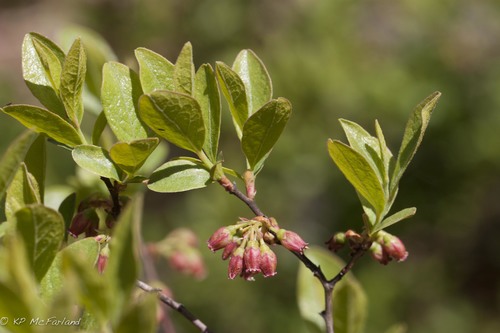
black huckleberry
Gaylussacia baccata
A champion of the eastern woods, the black huckleberry offers a summer bounty for birds and mammals alike. Recognizable by its unique resin-dotted leaves, this hardy shrub turns backyard corners into vibrant wildlife hubs.
Quick Identification
Size
Height ranging from 0.3 to 1.2 meters (1 to 4 feet); spread of 0.6 to 1 meter (2 to 3 feet)
Colors
Dull green leaves with golden resin dots; reddish-pink or greenish-yellow flowers; glossy black fruit
Key Features
- Golden-yellow resin dots on the underside of leaves
- Bell-shaped, tubular flowers in drooping clusters
- Fruits containing 10 hard, seed-like nutlets
- Twiggy, upright woody growth habit
When You’ll See Them
Geographic range
Where Does the black huckleberry Live?
The black huckleberry is a native fixture of the North American landscape, predominantly found across the eastern half of the continent. Its territory stretches from the maritime provinces of Canada, including Newfoundland and Nova Scotia, westward through Ontario and into the American Midwest. The core of its population resides along the Appalachian Mountains and the Atlantic Coastal Plain, reaching as far south as Georgia and Alabama. It is a quintessential species of the Eastern Deciduous Forest, thriving where many other plants struggle in sandy or rocky substrates.
Basemap © OpenStreetMap contributors
Behavior
Black huckleberry is a resilient, deciduous shrub that plays a foundational role in many eastern North American ecosystems. Unlike its cousin the blueberry, this species is characterized by a slower growth rate and a high tolerance for poor, acidic soils. It spreads primarily through underground rhizomes, often forming dense thickets that provide excellent cover for ground-nesting birds and small mammals.
Throughout the seasons, the black huckleberry undergoes a vibrant transformation. In late spring, it produces clusters of urn-shaped flowers that are a magnet for bumblebees and early-season butterflies. By mid-to-late summer, the shrub is laden with deep black berries. While it is a wild plant, its interaction with humans is most significant during the harvest season, as the berries are edible and highly prized for their intense, sweet-tart flavor, which many consider superior to commercial blueberries.
EverydayEarth exclusive
Camera Tips
To capture the wildlife that visits the black huckleberry, position your camera at a low height, approximately 12 to 24 inches off the ground. This height is ideal for spotting the wide variety of birds, such as Gray Catbirds and Eastern Towhees, that frequently hop through the branches to feast on the ripening berries in July and August. Angle the camera slightly upward to capture the activity within the foliage rather than just the ground below.
Because this shrub is a major food source, you don't need artificial lures or baits; the berries themselves are the primary draw. Set your camera to 'Burst Mode' or 'High-Speed Video' during the peak fruiting weeks. This allows you to catch the fast movements of pollinators like the Henry's Elfin butterfly on the flowers in spring, or the frantic feeding of small mammals like chipmunks and white-footed mice that gather fallen fruit at night.
Pay attention to the light. Black huckleberries often grow in dappled shade under oak or pine canopies. Adjust your camera's PIR (Passive Infrared) sensitivity to medium-high to ensure that small birds or mammals moving through the thin, twiggy branches trigger the sensor. If your yard has a large patch of huckleberry, focus your camera on a specific 'opening' or a particularly fruit-heavy branch to increase your chances of a clear, centered shot.
Late summer is the best time for trail camera monitoring, but don't overlook the autumn. The leaves of the black huckleberry turn a brilliant, fiery red, providing a stunning backdrop for any wildlife passing through your backyard. Ensure your camera lens is clean of any sticky resin that may blow off the leaves during high winds, as this species is notably resinous.
Similar Species
Species that look similar or are commonly confused with black huckleberry.
Frequently Asked Questions
Record black huckleberry at your habitat
Connect a camera to start building your own species record — AI identifies every visitor automatically.