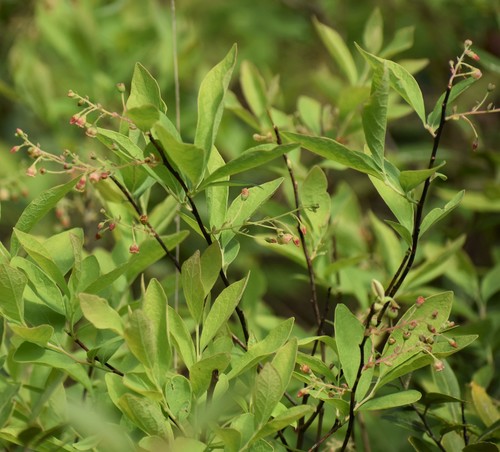
dangleberry
Gaylussacia frondosa
The Dangleberry is an elegant native shrub of the Eastern US, cherished for its pendulous blue fruit and stunning orange-red autumn leaves. A vital resource for backyard birds and pollinators, it adds a touch of wild grace to any acidic woodland garden.
Quick Identification
Size
1 to 2 meters (3 to 6 feet) in height and width
Colors
Dull green to blue-green leaves with a silvery-white (glaucous) underside; greenish-pink bell-shaped flowers; dark blue berries with a waxy coating
Key Features
- Drooping clusters of flowers and fruit on long, slender stalks
- Leaves feature tiny resinous dots and a distinct waxy white underside
- Bell-shaped blossoms ranging from white to greenish-pink
- Fruit is a glaucous blue berry, appearing later in summer
When You’ll See Them
Geographic range
Where Does the dangleberry Live?
The Dangleberry is a quintessential resident of Eastern North America, thriving in the acidic soils of the Atlantic coastal plain and Piedmont. Its native range extends from southern New Hampshire and New York, stretching southward through the mid-Atlantic states into South Carolina. While it is most concentrated near the coast, it can also be found in inland thickets and upland woods where the soil conditions are sufficiently acidic.
Basemap © OpenStreetMap contributors
Behavior
In the spring, it is a hub of activity for native pollinators, especially bumblebees and lepidoptera. As the seasons shift, the plant undergoes a dramatic transformation; its blue-green summer foliage turns into a vibrant display of oranges and deep reds in the autumn. It does not spread rapidly by runners, making it a well-behaved choice for native plant gardens.
EverydayEarth exclusive
Camera Tips
Because this shrub is a major food source, it acts as a natural magnet for wildlife. Position your camera to face a cluster of ripening berries during July and August. You are likely to capture incredible footage of Cedar Waxwings, Eastern Bluebirds, and Gray Catbirds as they hover or perch to pluck the fruit. To avoid 'false triggers' caused by the wind moving the slender branches, try to shield the plant with a temporary windbreak or use a camera with a zone-based motion sensor.
Early morning is the ideal time for photography, as the dew often clings to the glaucous underside of the leaves, creating a shimmering silver effect. If you are interested in pollinators, setting your camera to a high-speed burst mode or high-frame-rate video during the flowering period in late May will help you capture the rapid movements of visiting bumblebees and clearwing moths.
Similar Species
Species that look similar or are commonly confused with dangleberry.
Frequently Asked Questions
Record dangleberry at your habitat
Connect a camera to start building your own species record — AI identifies every visitor automatically.