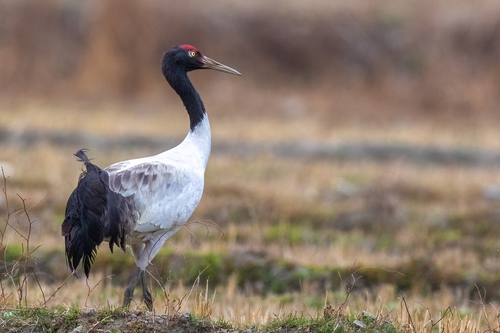
Black-necked Crane
Grus nigricollis
The 'Spirit of the Plateau,' the Black-necked Crane is a majestic symbol of high-altitude wilderness and spiritual devotion across the Himalayas.
Quick Identification
Size
Length: 139 cm (55 in); Wingspan: 235 cm (7.71 ft); Weight: 5.5 kg (12 lb)
Colors
Whitish-gray body with a black head, black upper neck, and black legs; distinctive red crown patch and a small white patch behind the eye; black flight feathers.
Key Features
- Vibrant red bald patch on the crown
- Black head and upper neck contrasting with white eye-spot
- Massive 7.7-foot wingspan with black primary feathers
- Elegant whitish-gray plumage
When You’ll See Them
Geographic range
Where Does the Black-necked Crane Live?
The Black-necked Crane is a specialist of the high-altitude heart of Asia, primarily native to the Tibetan Plateau. Its core breeding range spans the remote, windswept highlands of western China, with smaller populations nesting in the Ladakh region of India. When the harsh alpine winter arrives, these majestic birds migrate to lower-elevation valleys in Bhutan, southern Tibet, and parts of Yunnan and Guizhou provinces in China, seeking out marshes and agricultural fields where food is more accessible.
Basemap © OpenStreetMap contributors
Behavior
Black-necked Cranes are highly social and intelligent birds, often seen in pairs or family groups during the breeding season and larger flocks during the winter. They are famous for their elaborate courtship dances, which involve synchronized leaping, bowing, and loud trumpeting calls that can carry for miles across the thin mountain air. These displays aren't just for mating; they help strengthen the pair bond and maintain social hierarchy within the flock.
In the high-altitude regions where they live, these cranes are deeply integrated into local human cultures, particularly in Buddhist traditions. They are often perceived as symbols of longevity and peace. While they are naturally wary of humans, they have learned to coexist near remote Himalayan villages, often foraging in harvested barley and wheat fields where they are protected by local spiritual beliefs and conservation laws.
EverydayEarth exclusive
Camera Tips
Capturing the Black-necked Crane on camera requires a strategy focused on distance and patience. Because these birds are found in wide-open alpine meadows and wetlands, they have an incredible field of vision. Use a camera with a high-quality telephoto lens or place your AI-powered trail camera near known foraging spots like harvested grain fields or the edges of shallow wetlands. Avoid placing the camera directly in the middle of an open field, as the sudden appearance of a new object may spook them; instead, mask it against a fence post or a large rock.
For the best results, set your camera to take bursts of photos or short high-definition video clips. Their 'dancing' behavior—jumping and wing-flapping—is much more impressive in video format. Ensure your camera is equipped with a high-speed trigger to catch the movement. Since the Himalayan sun can be incredibly bright and the snow highly reflective, check your exposure settings to prevent 'blown out' white feathers in the mid-day sun.
Power management is crucial in the crane's habitat. The cold temperatures at 4,000 meters can drain standard batteries in hours. We highly recommend using lithium batteries or an external solar panel kit. Position the camera facing North or South to avoid direct lens flare from the low-hanging winter sun, and try to capture the birds during the 'golden hours' of shortly after sunrise or before sunset when they are most active and the light is most dramatic.
Similar Species
Species that look similar or are commonly confused with Black-necked Crane.
Frequently Asked Questions
Record Black-necked Crane at your habitat
Connect a camera to start building your own species record — AI identifies every visitor automatically.