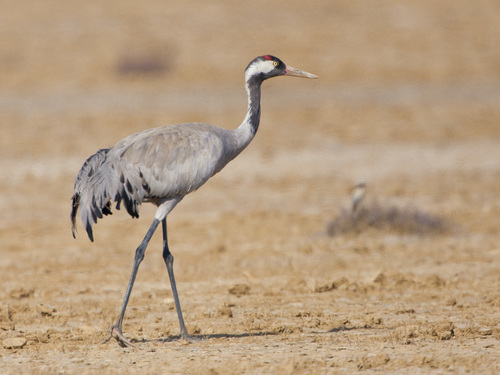
Common Crane
Grus grus
A symbol of fidelity and longevity, the Common Crane is one of Europe’s most majestic spectacles. With its haunting bugle call and elegant 'dancing' displays, this leggy wanderer transforms any backyard wetland into a stage for avian grace.
Quick Identification
Size
Length: 100–130 cm (39–51 in); Wingspan: 180–240 cm (71–94 in); Weight: 3–6 kg (6.6–13.2 lbs)
Colors
Slate-grey body plumage; black face, throat, and primary wing feathers; white stripe extending from the eye down the neck; adult birds feature a distinct bald red patch on the crown.
Key Features
- Slate-grey plumage with bushy 'bustle' feathers over the tail
- Black neck and face with a white stripe from eye to nape
- Red bare skin patch on the top of the head
- Loud, trumpeting bugle call audible over long distances
When You’ll See Them
Geographic range
Where Does the Common Crane Live?
Native to the Palearctic region, the Common Crane breeds across a vast territory spanning Northern and Eastern Europe through Siberia to Northern China. As a migratory species, it travels along well-defined flyways to wintering grounds in France, Spain, North Africa, the Middle East, and Southern Asia. In recent decades, conservation efforts have successfully expanded its range back into the United Kingdom and parts of Western Europe where it was previously extirpated.
Basemap © OpenStreetMap contributors
Behavior
Common Cranes are highly social and intelligent birds known for their complex social structures and spectacular displays. They are famous for their 'dancing,' which involves bowing, jumping, and throwing tufts of grass into the air. While these dances are most common during the breeding season to strengthen pair bonds, they are also performed by young birds and even during wintering as a form of social play or tension relief.
As powerful flyers, they migrate in classic V-formations or long lines, utilizing thermal updrafts to cover hundreds of kilometers a day. They are extremely wary of humans and will maintain a large 'flight distance,' taking to the air at the slightest sign of a perceived threat. In their wintering grounds, they congregate in large communal roosts, often in shallow water, to protect themselves from predators like foxes and wolves.
EverydayEarth exclusive
Camera Tips
Capturing the Common Crane on camera requires patience and strategic placement. Because they are exceptionally tall birds, you should mount your camera approximately 0.5 to 0.8 meters (20-30 inches) off the ground. Angle the lens slightly upward to ensure you capture their entire profile, including the distinctive red crown and long neck. If you place the camera too low or flat, you may only get footage of their legs.
Focus your camera on 'transition zones'—the areas where a wetland meets an open field. Cranes often land in the center of fields for safety and then walk toward the edges to forage. Look for footprints in soft mud or 'bill-stabbing' marks in the soil as indicators of their presence. Since they are highly sensitive to new objects, use a camera with a 'no-glow' or black LED infrared flash. Camouflaging the camera body with local vegetation or burlap can help prevent them from spotting the device and avoiding the area.
Settings are crucial for these birds. Use a 'Burst' or 'Multi-shot' mode with at least 3-5 frames per trigger. Cranes have a very deliberate, slow gait, but their social interactions—like wingspreading or jumping—are sudden and fast. A high-speed trigger and a short recovery time will allow you to capture these behaviors. During the migration season, early morning light provides the best clarity; set your camera to its highest resolution to capture the fine detail of their slate-grey feathers.
Similar Species
Species that look similar or are commonly confused with Common Crane.
Frequently Asked Questions
Record Common Crane at your habitat
Connect a camera to start building your own species record — AI identifies every visitor automatically.